
I have been testing AI chatbots since GPT-3 made people’s jaws drop in 2020. By now, the novelty has long worn off.
These days, I use the AI tools daily across actual work: writing, research, coding, document analysis, and the kind of messy multi-step thinking that used to take an afternoon.
Over the past four months, I paid for every major tier that mattered, switched between them daily, and tracked where each one earned its keep and where it quietly failed.
This is not a benchmark roundup dressed as a review. The numbers are here because they matter, but the ranking comes from use.
The chatbots I tested are ChatGPT (GPT-5.5), Claude (Sonnet 4.6 and Opus 4.6), Gemini 2.5 Pro, Perplexity Pro, Grok 4.3, and Microsoft Copilot. All tested on paid tiers, all tested in May 2026.
TL;DR: After four months of paid daily use across six major AI chatbots, Claude Sonnet 4.6 is the best all-round tool for most people, with ChatGPT GPT-5.5 close behind for agentic and creative tasks. Gemini 2.5 Pro leads on multimodal work and Google Workspace integration. Perplexity is the only one worth using for cited research. Grok 4.3 is fast and cheap but inconsistent. Copilot is excellent if you live in Microsoft 365 and largely pointless if you do not.
Best AI Chatbot: How the ranking works
Every chatbot was tested across six task categories: writing and editing, multi-step reasoning, coding, document analysis, real-time research, and day-to-day usability.
Each category was weighted based on the tasks a general professional user actually performs, not on what benchmark labs find interesting to measure.
Benchmark scores are used as supporting evidence, not as the basis of the ranking itself.
The LMArena leaderboard (the rebranded LMSYS Chatbot Arena, which has run since May 2023 and has over 6 million blind pairwise votes as of mid-2026) is cited where relevant because it reflects real human preference rather than self-reported lab scores.
SWE-bench Verified is used for coding comparisons because it measures the resolution of real GitHub issues, which is the closest publicly available proxy for practical software engineering ability.
Pricing is evaluated at the consumer tier most people would actually pay for, meaning the $20/month tier where it exists.
1. Claude Sonnet 4.6 is best overall
The model that surprised me most in this testing cycle was not the expensive flagship.
It was Claude Sonnet 4.6, which Anthropic released on February 17, 2026, and which has quietly become the chatbot I reach for first in almost every situation.
The numbers that explain why: Sonnet 4.6 scores 79.6% on SWE-bench Verified, just 1.2 percentage points behind Opus 4.6 (80.8%) while costing five times less at $3 per million input tokens versus $15.
On ARC-AGI-2, a test of novel problem-solving that most previous models handled poorly, Sonnet 4.6 jumped from 13.6% to 58.3% in a single generation. That is not an incremental improvement. It is a qualitative shift in how the model handles unfamiliar problems.
In practice, the thing I noticed first was not speed or any single answer. It was that the model reads the context of a request more carefully than anything else I tested.
When I sent it a 40-page contract and asked it to flag clauses that conflicted with a separate policy document, it did not miss anything.
When I sent the same task to GPT-5.5, I got a solid answer, but it reorganised the findings in a way that required me to cross-reference back to the original.
This might come across as a small difference that becomes meaningful across dozens of similar tasks per week.
On the LMArena leaderboard (May 2026 snapshot), Claude Opus 4.6 holds the number one text arena Elo at 1418, with Sonnet 4.6 tracking close behind.
Sonnet 4.6 also holds a coding Elo of 1561 on the coding sub-leaderboard, which the platform notes is the first time any model has cleared 1500.
Writing quality is the other strong suit. Claude’s prose avoids the particular kind of AI flatness that makes GPT outputs identifiable to anyone who reads them regularly. It has a rhythm to it.
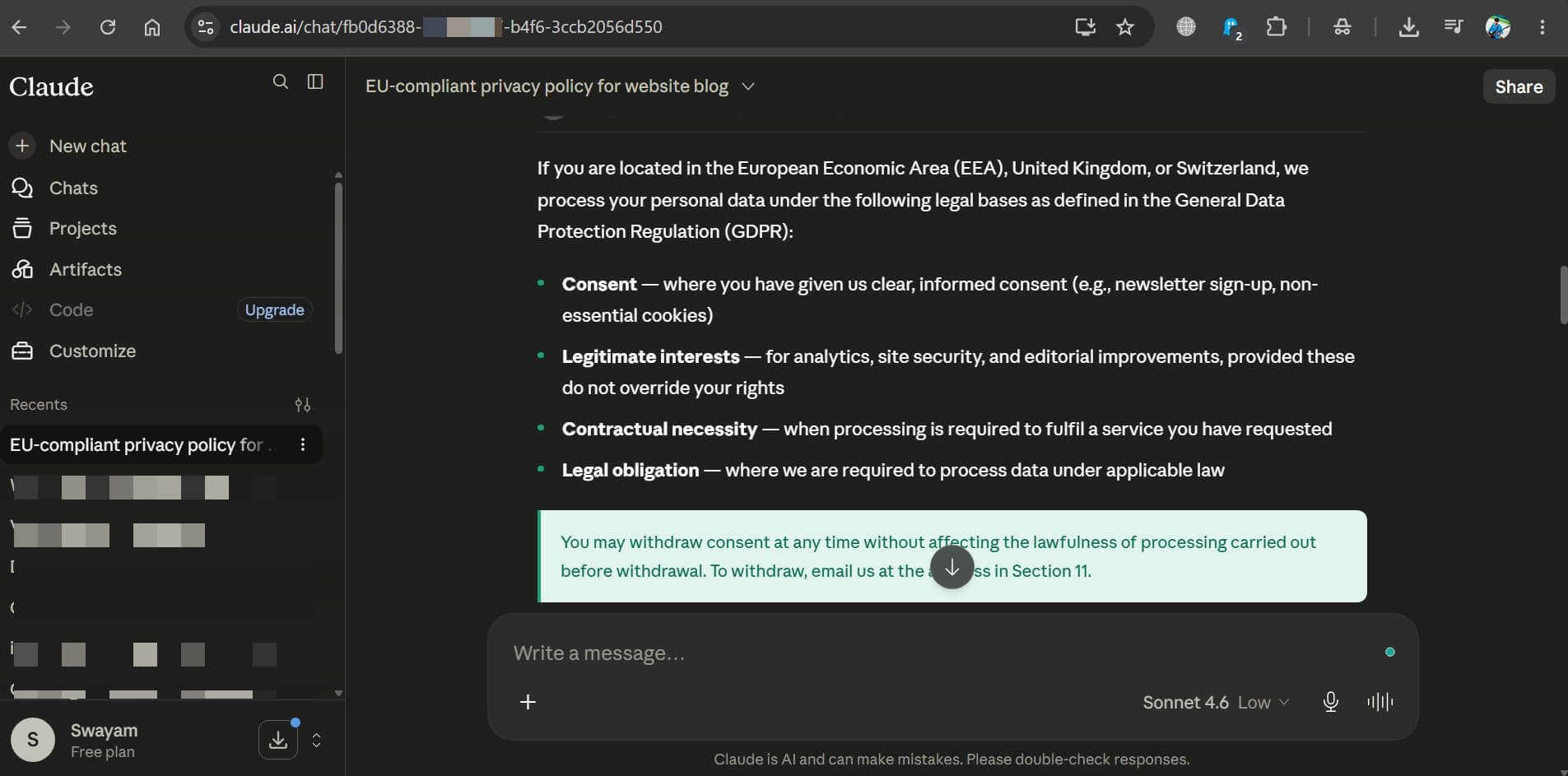
I stopped editing the first paragraph of drafts generated on Claude almost entirely after the first two weeks, which is something I had never done with any previous model version or even with other AI tools I have tested for writing.
The free tier now includes file creation, connectors, and context compaction, which were previously Pro-only features.
For users with a Claude AI subscription, Claude Pro is $20 per month. The Claude Max plan at $100 per month unlocks higher rate limits and Opus 4.6 access for users who need deeper reasoning on hard problems.
The Anthropic AI tool is not free of shortcomings. Claude does not have real-time web access built into the consumer interface by default in the same persistent way as Perplexity or Grok.
Web search exists, but it is not the primary architecture. At least not the way it is for Perplexity. For live news and real-time fact-checking, you will notice the difference.
2. ChatGPT (GPT-5.5) is best for agentic and creative work
ChatGPT is the Honda Civic of AI, as one analyst put it in a May 2026 pricing comparison. It does everything competently, most people know how to use it, and the upgrade path is clear.
GPT-5.5 launched on April 23, 2026, and represents a meaningful step over its predecessor on agentic tasks specifically.
On Terminal-Bench 2.0, a benchmark for autonomous multi-step workflows involving coding, browser automation, and file operations, GPT-5.5 scores 82.7%. That is 17 percentage points ahead of what Claude Opus 4.6 achieves on the same test (65.4%).
For tasks that require the model to take a sequence of actions without checking in after every step, GPT-5.5 is meaningfully better than anything else I tested.
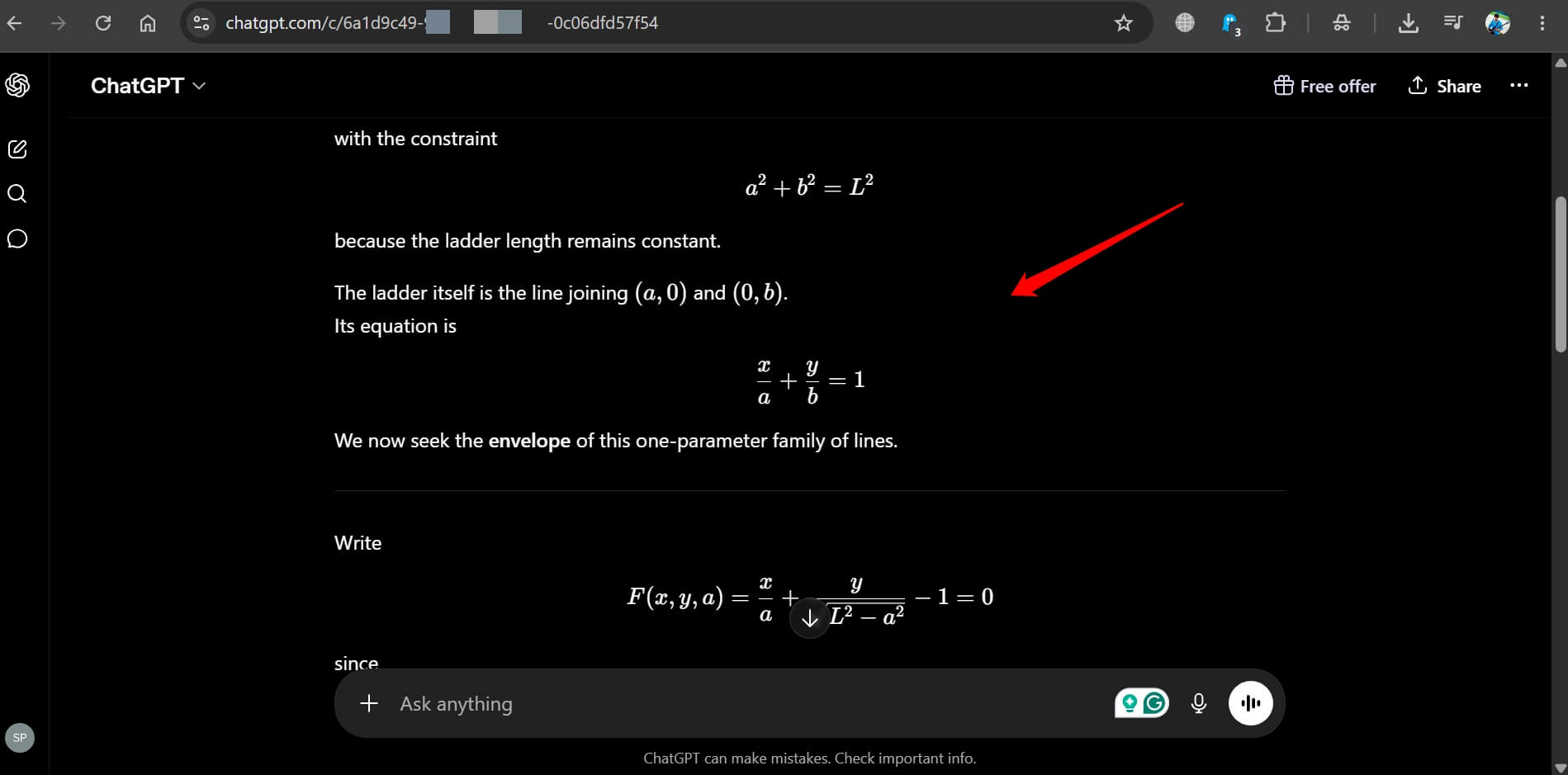
The 1 million token context window, now standard across the API, is real and functional. I tested it by loading an entire TypeScript codebase (roughly 280,000 tokens) alongside a detailed feature specification.
GPT-5.5 navigated that correctly, and so did Claude Sonnet 4.6. Both are capable here; GPT-5.5 is slightly faster on large-context completions in my experience, though latency may vary by time of day and server load.
Where GPT-5.5 earns its lead over Claude for some users is in the creative range. Image generation via ChatGPT Images 2.0 is genuinely good, and the model switches between generating a diagram, explaining its contents, and revising it based on feedback within a single conversation in a way that feels natural. No other chatbot I tested handles that loop as cleanly.
The voice mode is also the best consumer voice AI experience available right now. After using it for calls, navigation notes, and quick idea capture for three weeks, I stopped reaching for my phone’s native voice assistant for anything that required more than one sentence. That is a behaviour change I did not expect.
I have also tested ChatGPT’s image generation capabilities. Turns out ChatGPT makes bolder images compared to other AI tools.
The pricing issue is quite real. GPT-5.5 is available on Plus at $20 per month, but the API is $5 per million input tokens and $30 per million output tokens, exactly double GPT-5.4. For developers building on top of it, that cost differential is worth scrutinising before committing.
ChatGPT experience was not without a friction point. I felt GPT-5.5 occasionally over-explains. When I asked it to fix a specific bug in a Python function, it sometimes rewrote adjacent code that did not need touching.
It even explained some additional info in two paragraphs that I had not asked for. Claude and Gemini were more surgically precise on targeted edits in my testing.
3. Gemini 2.5 Pro is best for multimodal and Google integration
Gemini 2.5 Pro is the chatbot I recommend to anyone whose daily workflow runs through Google. It sounds like a narrow category, but it describes a substantial portion of the professional world.
Most folks have their workforce wrapped around Google Docs, Sheets, Gmail, or Meet for most of their working day. Interestingly, Gemini is present across all the Google products, which makes it easier to use the AI tool.
The model scores approximately 78% on SWE-bench Verified, 90% on MMLU, and leads on mathematical reasoning with 92% on AIME 2024 benchmarks.
On GPQA Diamond, the PhD-level science reasoning benchmark, Gemini 3.1 Pro (the preview version released February 19, 2026) scored 94.3%, topping the field, though that model remains in preview status with no SLA and reported 41-second time-to-first-token latency that makes it difficult to recommend for daily use. The stable Gemini 2.5 Pro is the practical choice.
Native multimodality is where Gemini genuinely leads. The model was built to process text, images, video, and audio within a single context from the start, not retrofitted.
I tested it by loading a one-hour product demo recording alongside its transcript and asking it to identify timestamp discrepancies between what was said and what was shown on screen. It found three.
I did not know those three discrepancies existed before I started. That kind of task is simply not possible with the same reliability as any other chatbot in this comparison.
The 1 million token context window is the same headline number as Claude and ChatGPT, but Gemini implements a 2x surcharge past 200,000 tokens on the API. At the consumer level, this does not come up, but it is worth knowing for API users doing large document processing.
I honestly felt Gemini’s prose writing is good, but slightly more generic in register than Claude AI. For drafting client-facing communications, I consistently found myself doing more light editing on Gemini outputs than on Claude’s.
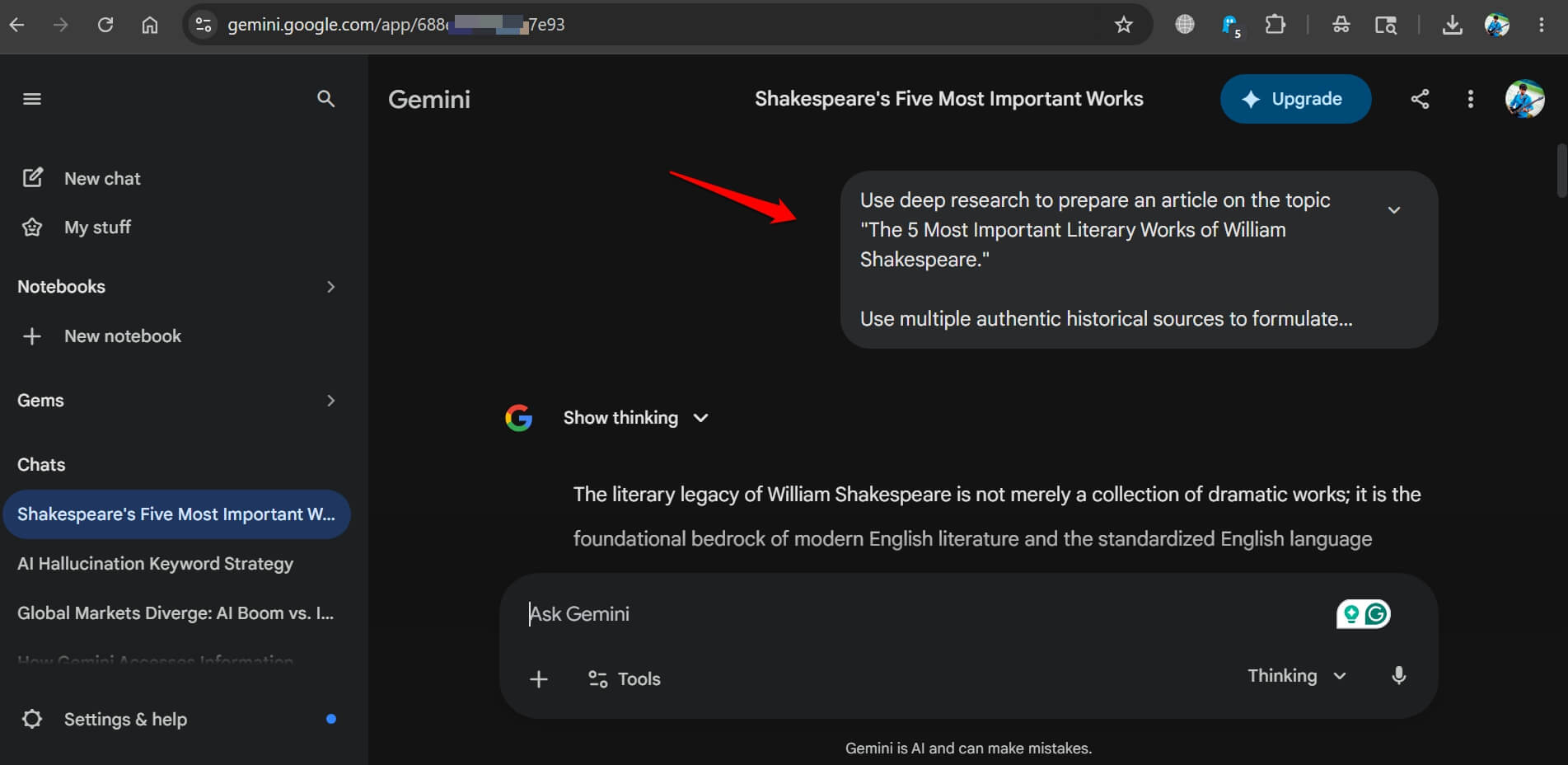
For data-heavy documents, tables, and anything involving structured extraction from messy inputs, Gemini is excellent.
Pricing for Gemini Advanced (the consumer tier) sits at approximately $19.99 per month through Google One, which bundles 2TB of cloud storage. If you are already paying for Google One storage, the AI access is effectively included in the price you are likely already paying.
4. Perplexity Pro is great for research with citations
Perplexity is the only chatbot in this comparison that was designed from the ground up as a search engine rather than a language model with search added on top.
The architectural difference is real with Perplexity, and it shows up in practice in a way that you can trust the sources.
When I asked Perplexity to summarise the current state of solid-state battery development for commercial vehicles, it returned a structured answer with seven numbered citations, all of which resolved to real, current primary sources.
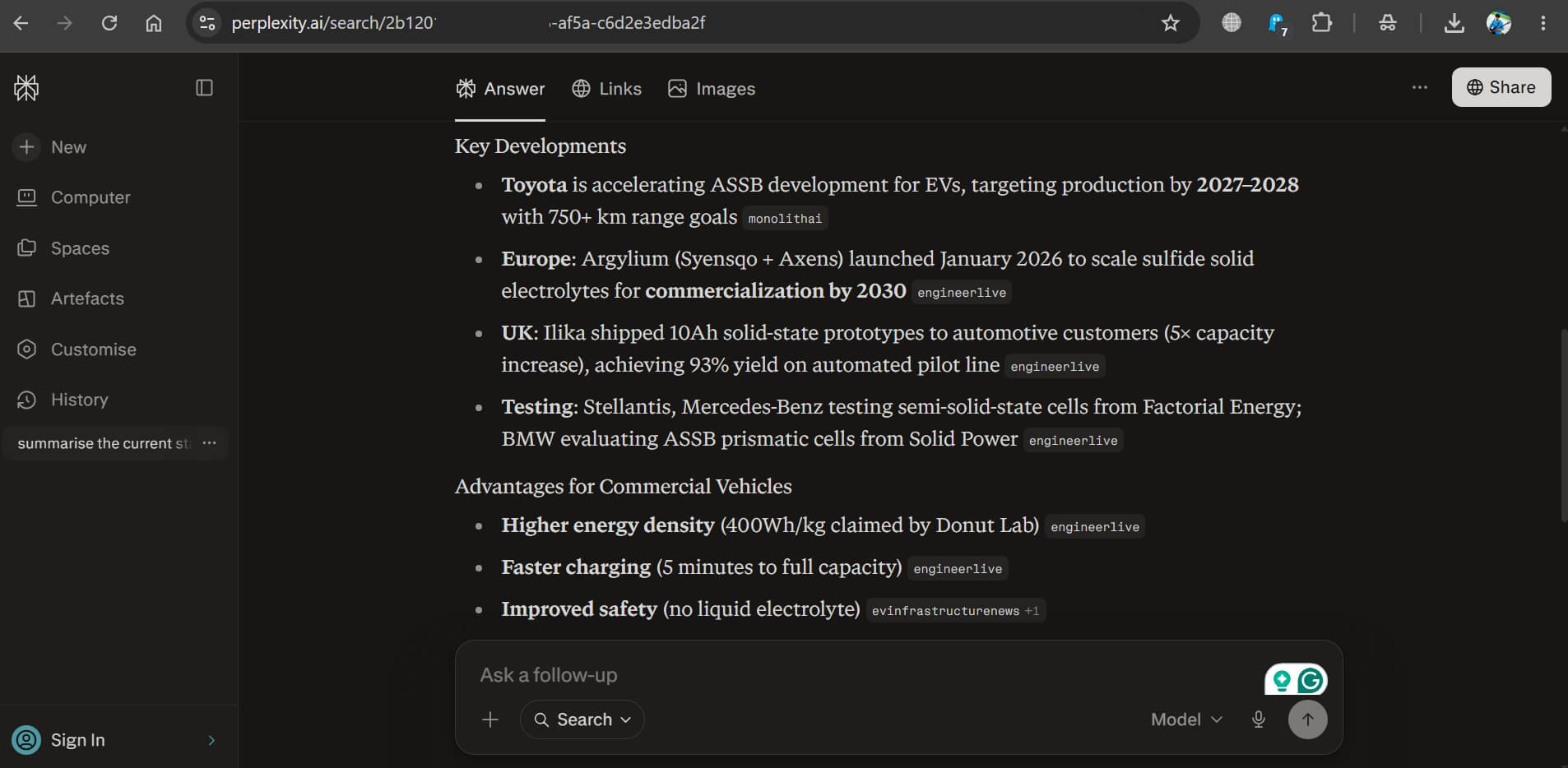
When I asked GPT-5.5 the same question, the answer was fluent and comprehensive but included one source that did not exist and another that was three years out of date. Perplexity’s citation-first design makes it the most reliable tool for research where provenance matters.
A comparison published in April 2026 put Perplexity’s factual accuracy at 92% versus ChatGPT’s 87% on search-grounded queries. That 5-point gap is not enormous in absolute terms, but it compounds when you are using the tool for research that feeds into published work or business decisions.
The Pro Search feature, which runs multi-step searches across 20 to 30 sources before synthesising a response, is the product’s headline capability. Five are available per day on the free tier, which is enough to evaluate the product.
Pro subscription at $20 per month removes that limit and adds frontier model access, including GPT-5, Claude, and Gemini model switching.
So, does this make Peplexity perfect enough for all kinds of tasks? Is it one of the best AI tools one can go for? I think it is a decent general-purpose assistant. I tried using it for long-form drafting, code debugging, and document editing.
The AI tool handled all of the tasks I put it through, but the model’s design optimises for retrieval and synthesis, not for the kind of extended, context-aware generation that Claude and ChatGPT excel at.
After three weeks of testing, I found a pattern. Perplexity is useful for any research task where I need to cite sources. Claude or ChatGPT for anything involving generation or editing.
5. Grok 4.3 offers Best Value API with an inconsistent consumer experience
Grok 4.3, released April 30, 2026, is where xAI’s pricing story becomes genuinely interesting.
At $1.25 per million input tokens and $2.50 per million output tokens, it is the cheapest frontier-capable API currently available. This is roughly 4 to 5 times cheaper than Gemini 2.5 Pro and 12 times cheaper than Claude Opus 4.6 on output tokens.
For cost-sensitive production workloads that do not require peak reasoning performance, that is a meaningful number.
The real-time X (Twitter) data access is the consumer-level differentiator that no other chatbot matches. When I needed to track the sentiment shift around a specific product announcement in real time, Grok returned posts, engagement patterns, and emerging narratives from the past 48 hours.
The other chatbots either acknowledged they could not access the data or returned information that was days or weeks old. For social listening, trend tracking, or anything involving the current X conversation, Grok is the only tool with genuine native access.
The inconsistency issue: Grok’s responses on complex analytical tasks showed more variability than any other chatbot I tested.
On a set of ten logic problems, I ran across all six models. Grok scored correctly on seven out of ten, identical to Gemini. But the three failures were more confident in their errors than any other model’s failures.
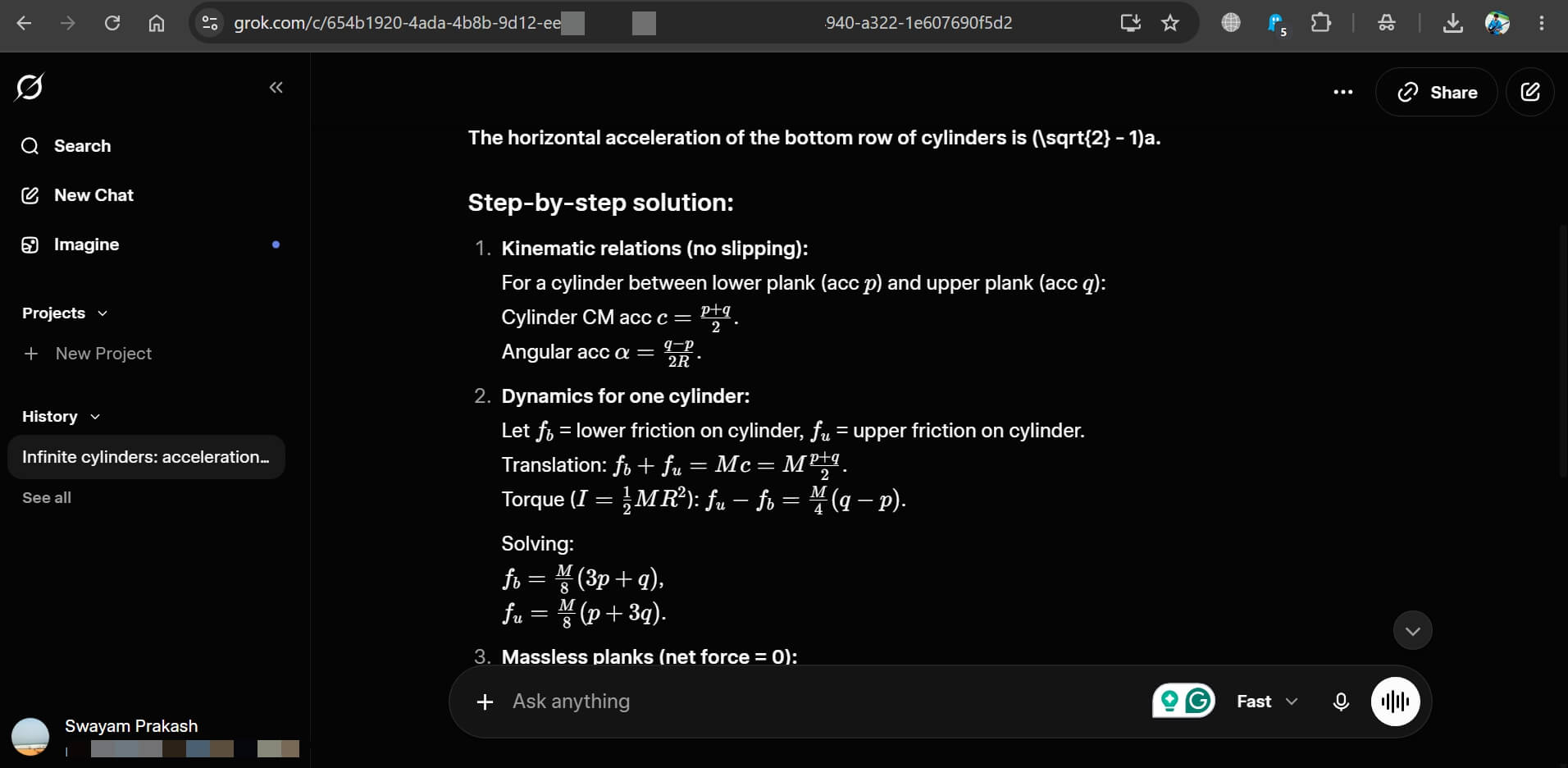
The model does not always signal uncertainty clearly when it is uncertain, which is a problem for users who rely on the tool for research without cross-checking. Also, Grok takes a considerable amount of time before throwing a response back at the query.
The consumer tier structure is also confusing. SuperGrok at $30 per month gives access to Grok 4 and 4.1 with a 128K context window and approximately 100 prompts per 2-hour window.
Full Grok 4.3 access requires SuperGrok Heavy at an outrageous $300 per month, which is 15 times the price of ChatGPT Plus. For most individual users, the $30 SuperGrok tier is the entry point that makes sense.
One small observation from daily use that I did not expect: Grok’s writing tone is noticeably more casual than every other chatbot in this comparison. Not unprofessional, just conversational in a way that other models are not by default.
For drafting social posts or informal communications, I found myself preferring it over Claude’s slightly more formal register. For anything client-facing or formal, the opposite was true.
6. Microsoft Copilot is perfect for Microsoft 365 Users
This ranking is entirely conditional on one question: Do you spend most of your working day inside Microsoft 365 applications?
If the answer is yes, Copilot is the most immediately practical AI tool in this list. It reads your actual Word documents, Excel models, Outlook threads, and Teams meetings. We have explained how to use Copilot AI on Windows 11 to guide you in using the AI tool.
When I asked Copilot to draft a response to an email chain, it had the full context of the existing thread without me pasting anything.
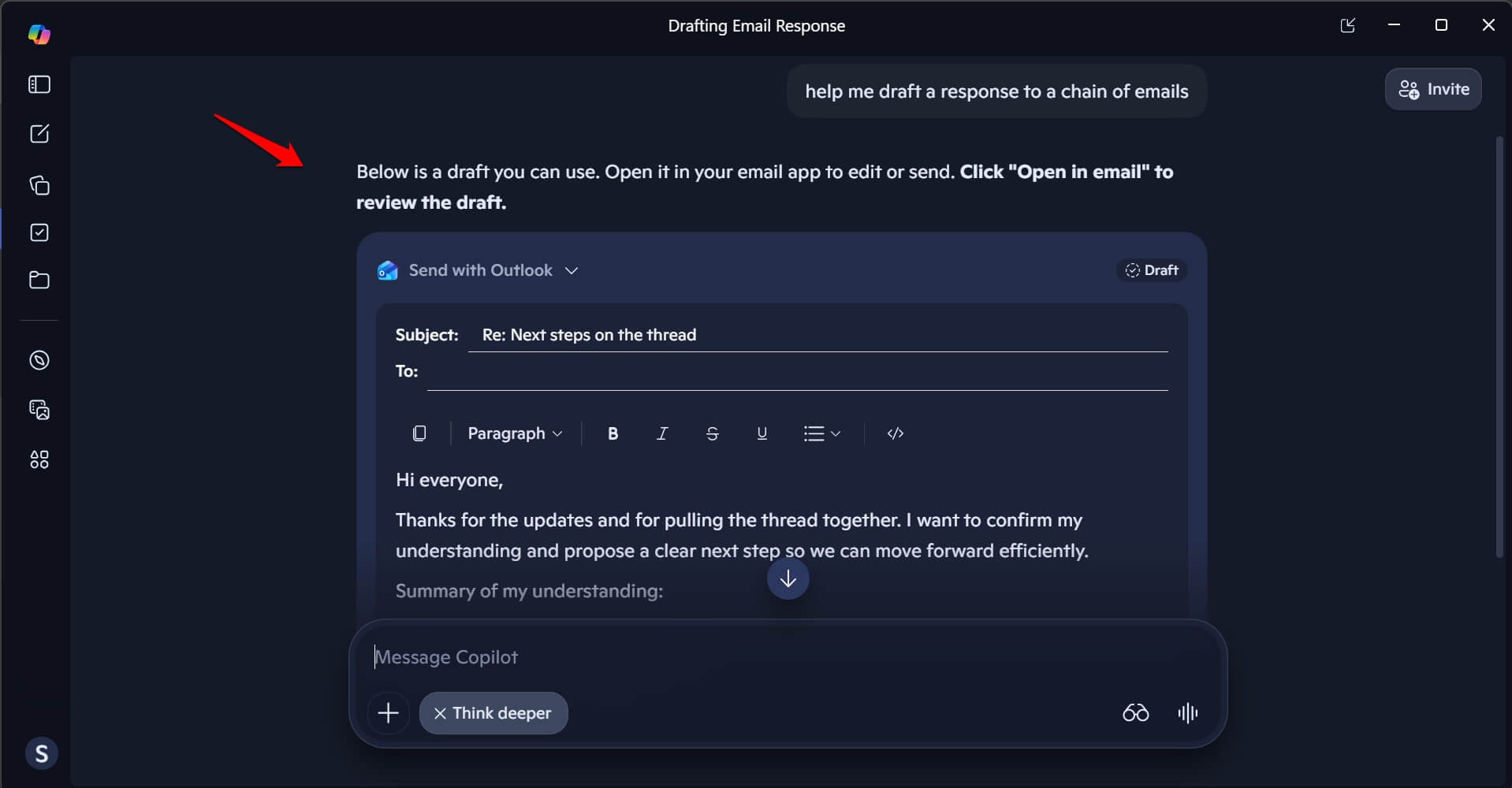
Again, I asked it to create a monthly summary from a SharePoint folder of reports. It did it without me opening a single file. That is not something any other chatbot can do by default without significant setup.
Microsoft 365 Copilot is priced at $30 per user per month as a business add-on, on top of existing M365 licensing.
For individual consumers, Microsoft 365 Personal now bundles Copilot access at $9.99 per month, making it one of the more cost-effective AI subscriptions if the Office apps are also in use.
If the answer to the Microsoft ecosystem question is no, Copilot drops to the bottom of this list. Outside the Microsoft integration context, it is a GPT-5.5-powered chatbot with less flexibility, fewer customisation options, and a more constrained interface than ChatGPT itself. There is no logical reason to choose it over Claude or ChatGPT for general use.
I want to be specific about what the Microsoft integration means in practice. After two weeks of using Copilot as my primary work assistant, I noticed I was spending about 25 fewer minutes per day on document formatting and email drafting.
That is not a subjective impression. I tracked it because I was curious. Whether that justifies $30 per user per month depends on what your time costs.
Where each AI tool actually fell short
ChatGPT had the most noticeable hallucination problem in long-context tasks. GPT-5.5 claims a 60% reduction in hallucinations versus GPT-5.4, and on short queries, that improvement is evident.
On tasks involving a large document and multiple sub-questions, I caught factual errors in about one in six complex responses. Not frequently, but often enough that verification became a habit.
Claude occasionally refused tasks that it should have handled. This happened perhaps once every three or four days across the testing period, usually on questions involving hypothetical scenarios or competitive analysis.
The refusals were always polite and sometimes offered a reframed alternative, but the pattern became slightly predictable and added friction in edge cases.
Gemini 2.5 Pro in the consumer interface still feels slightly disconnected from the Google ecosystem for users who do not pay for Workspace. The integration that makes it so useful for business users is not the same experience on personal accounts. The model quality is the same, but the context access that makes it genuinely powerful is not.
Perplexity struggles with tasks that require sustained, multi-turn generation. It handles single-prompt research well, but if you need to work through a document over fifteen or twenty exchanges, the conversation loses coherence faster than Claude or ChatGPT does.
Grok’s knowledge cutoff is officially November 2024, according to xAI’s API documentation. For a chatbot whose main differentiator is real-time data access, the static knowledge base being eight months behind the current date creates an odd gap.
The live X data fills part of this, but it does not cover news from other sources in real time, the way Perplexity does.
Copilot outside of Microsoft applications. Already covered, but worth repeating: it is not a general-purpose tool and does not try to be.
The honest verdict on free tiers
Four of the six tools have genuinely usable free tiers, which was not true twelve months ago.
Claude’s free tier now includes file creation and context compaction. Perplexity’s free tier gives unlimited basic search with citations plus five Pro searches daily.
Grok’s free tier is 10 prompts every two hours. ChatGPT’s free tier now carries advertisements in the US and some other markets, which is worth knowing before you commit to it as your daily driver.
For a user who does light research and occasional drafting, the Claude free tier, plus the Perplexity free tier, together cover most common AI tasks without a subscription. That combination was not viable six months ago. It is now.
Ranking Summary
| Chatbot | Model (May 2026) | Free Tier | Paid Tier | Context Window | SWE-bench Score | Best For |
|---|---|---|---|---|---|---|
| Claude | Sonnet 4.6 / Opus 4.6 | Yes (capable) | $20/mo (Pro) | 1M tokens | 79.6% (Sonnet) | Writing, coding, documents |
| ChatGPT | GPT-5.5 | Yes (ads on free) | $20/mo (Plus) | 1M tokens | 82.7% Terminal-Bench | Agentic tasks, voice, creative |
| Gemini | 2.5 Pro | Yes | $19.99/mo | 1M tokens | 78% (SWE-bench) | Multimodal, Google Workspace |
| Perplexity | Multi-model | Yes (5 Pro/day) | $20/mo (Pro) | Varies | 92% search accuracy | Cited research, fact-checking |
| Grok | 4.3 | Yes (10 prompts/2hr) | $30/mo (SuperGrok) | 1M tokens | 75% (general reasoning) | Real-time X data, low API cost |
| Copilot | GPT-5.5 (Microsoft) | Limited | $9.99/mo personal | 1M tokens | Same as GPT-5.5 | Microsoft 365 integration |
1. Claude Sonnet 4.6: Best all-round. Strongest writing quality, excellent coding, 79.6% SWE-bench, 1M context at $3 per million tokens. Free tier is genuinely capable.
2. ChatGPT GPT-5.5: Best for agentic workflows and creative tasks. 82.7% on Terminal-Bench 2.0, best voice mode, strongest for multi-step autonomous tasks. $20 per month on Plus.
3. Gemini 2.5 Pro: Best multimodal and best for Google Workspace users. Strongest native video and audio processing. 94.3% GPQA on the 3.1 Pro preview. $19.99 per month.
4. Perplexity Pro: Best for sourced research. 92% factual accuracy on search queries, citation-first architecture, multi-model access. $20 per month.
5. Grok 4.3: Best API value and real-time X data. $1.25 per million input tokens. Inconsistent in complex reasoning. $30 per month consumer tier for SuperGrok.
6. Microsoft Copilot: Best Microsoft 365 integration. Irrelevant outside that context. $9.99 per month personal, $30 per user per month business.
Ranking methodology
Each chatbot was used on a paid subscription tier for a minimum of four weeks. All subscriptions were purchased at standard retail prices.
Benchmark data used in this article: SWE-bench Verified (real GitHub issue resolution), Terminal-Bench 2.0 (autonomous multi-step agentic tasks), ARC-AGI-2 (novel problem-solving), GPQA Diamond (PhD-level science reasoning), LMArena Elo (blind human preference votes, 6 million+ accumulated), and the factual accuracy comparison from the April 2026 Perplexity versus ChatGPT evaluation published at tech-insider.org.
Pricing is verified against each platform’s public pricing pages as of May 2026. Regional pricing may differ. Benchmark scores cited are from independent evaluation sources or from official Anthropic, OpenAI, Google, and xAI release documentation.
Frequently asked questions
Which AI chatbot is best for beginners in 2026?
Claude’s free tier is the most capable entry-level option right now. It includes file creation and context compaction with no subscription, and the interface is straightforward. ChatGPT’s free tier works but carries ads in the US.
Is Claude better than ChatGPT in 2026?
For writing quality and document analysis, Claude Sonnet 4.6 edges ahead. For agentic multi-step tasks and voice mode, ChatGPT GPT-5.5 leads. Both are within a few percentage points on most benchmarks.
Which is the best AI chatbot that is most accurate for research?
Perplexity Pro, at 92% factual accuracy on sourced queries in April 2026 testing. It is the only chatbot in this comparison architecturally designed around citations rather than generation.
Is Grok worth paying for in 2026?
SuperGrok at $30 per month is worth it if you need real-time X data or low-cost API access. For general daily use, Claude or ChatGPT at $20 per month offers more consistent quality.
What is the cheapest frontier AI chatbot in 2026?
Grok 4.3 at $1.25 per million input tokens is the cheapest capable frontier model on the API. For consumer tiers, Claude, ChatGPT, Perplexity, and Google AI Pro are all priced at $20 per month.


Very thorough comparison! I personally use Claude for coding and recently discovered pictro.ai for AI image generation. It is a free tool that works really well for quick visual content creation. Worth adding to the image generation category in a future update.