
The Play Store has hundreds of video editors. Most of them follow the same arc: simple enough to cut one clip, frustrating the moment you try to do anything more involved. KineMaster kept showing up on every shortlist I came across, so I finally gave it a proper run across several weeks of real projects including a short product promo, a few YouTube explainers, and a handful of Instagram Reels.
It has over 100 million downloads on Android and iOS combined. Before using it, that number felt like marketing. After, it makes complete sense.
What is KineMaster?
KineMaster is a professional mobile video editor for Android and iOS, built by KineMaster Corporation, a company headquartered in Seoul, South Korea. It has been around since 2002 and the current app reflects years of iteration rather than a first attempt at solving mobile editing.
The feature list is longer than most phone editors: multi-layer video editing, chroma key compositing, multi-track audio mixing, volume envelope control, 3D transitions, keyframe animation, real-time effects, and 4K export. It runs on Android, iOS, and Chromebook. There is no official desktop app.
Interface: more logical than it first appears
Opening KineMaster for the first time presents three options: start a new project, browse the asset store, or visit the YouTube channel. Most people will tap New Project immediately. The store is worth exploring eventually, but the first session makes more sense spent learning the editing layout.
The first decision when creating a project is aspect ratio. 16:9 for landscape YouTube content, 9:16 for vertical Reels and Shorts, 1:1 for square posts. This choice shapes everything that follows, so it is worth making deliberately. Changing it after the fact means re-exporting.
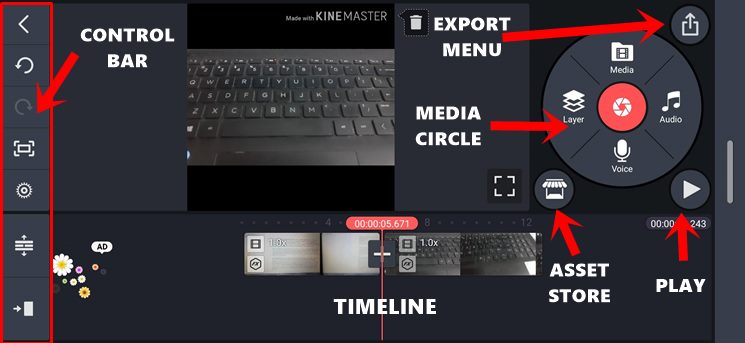
Inside the editor, the video preview sits at the center of the screen. A control bar on the left holds Undo, Redo, Project Settings, and Share. A circular media wheel in the top right is where you add new clips, audio tracks, voice recordings, and layers. The timeline runs along the bottom, showing your clips with their durations and any applied edits.
The layout feels busy in the first session. By the second project, you stop noticing it. The muscle memory builds faster than expected because the tools are grouped by what they act on rather than what they are called.
Trimming, speed control, and per-clip adjustments
Tapping any clip in the timeline surfaces its editing panel. From here you can trim, split, reverse, pan and zoom, and adjust the clip’s audio level independently of everything else on the timeline. The speed control ranges from 0.25x slow motion to 2x fast-forward, with a smooth ramp between values rather than hard steps.
Precision trimming works well on larger screens. On a phone with a 6-inch display, dragging trim handles to a specific frame is comfortable. On anything smaller, you will occasionally overshoot by a frame. Pinching the timeline to zoom in gives more granular control over this, though the gesture is not surfaced anywhere obvious and most people discover it by accident.
The Clip Graphics option adds an effect to a specific portion of a selected clip. The built-in effects library is more substantial than the free tier usually implies. With some restraint in selection, the results do not look templated.
Download KineMaster on Android
Multi-layer editing: where KineMaster earns its reputation
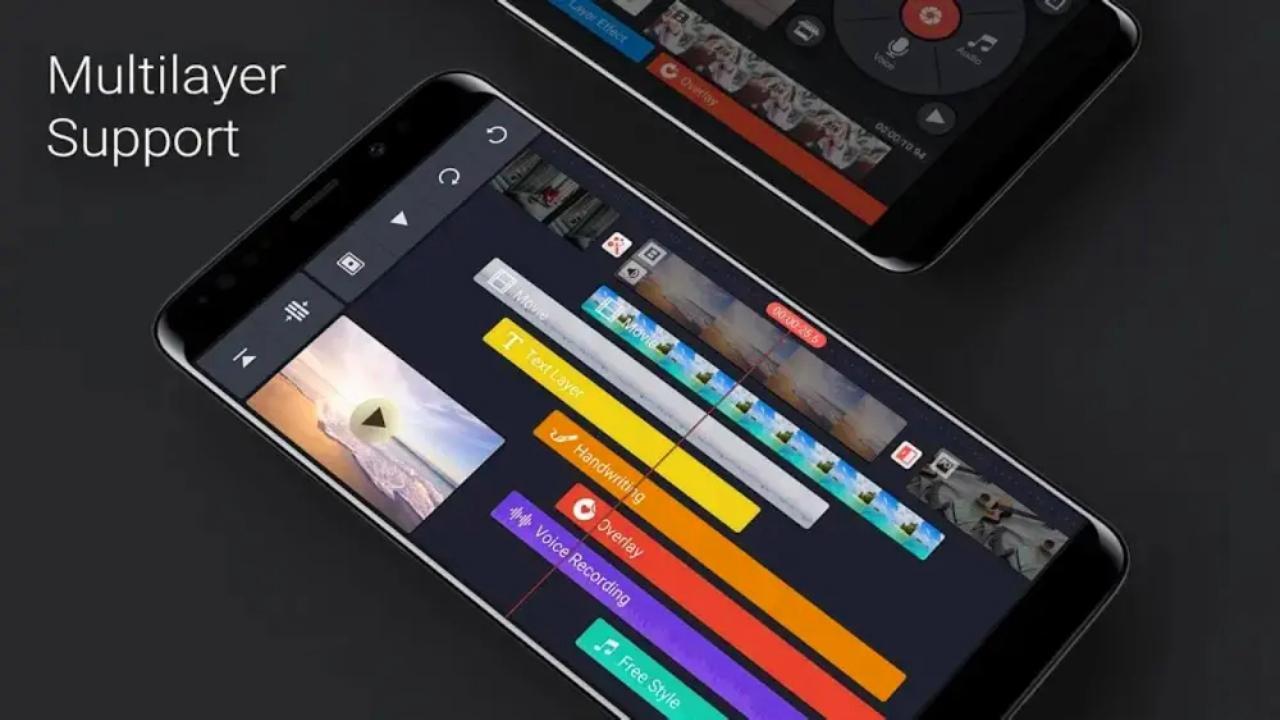
The Layer option from the media wheel is what separates KineMaster from most mobile editors. It lets you place a second video clip, an image, a text overlay, a handwritten annotation, or a sticker as an independent layer sitting on top of your primary footage, without the two ever interfering with each other.
Each layer carries its own set of controls: position, scale, opacity, in and out animations, color filters, reverb, and audio settings. Adjusting any of these touches only that layer. The clip below stays exactly as it was.
I used this to add a logo to a short product video. The logo sat in the lower corner, faded in over half a second using the in-animation control, and stayed there for the full duration. The whole setup took about two minutes. The result looked like something produced on a desktop timeline.
One thing worth knowing: if your base clip already has a transition applied and you stack a second transition on a layer above it, the two effects compound and the video starts to feel restless. Keeping transitions on one level at a time produces a cleaner result.
Chroma key: green screen on a phone, and it mostly holds up
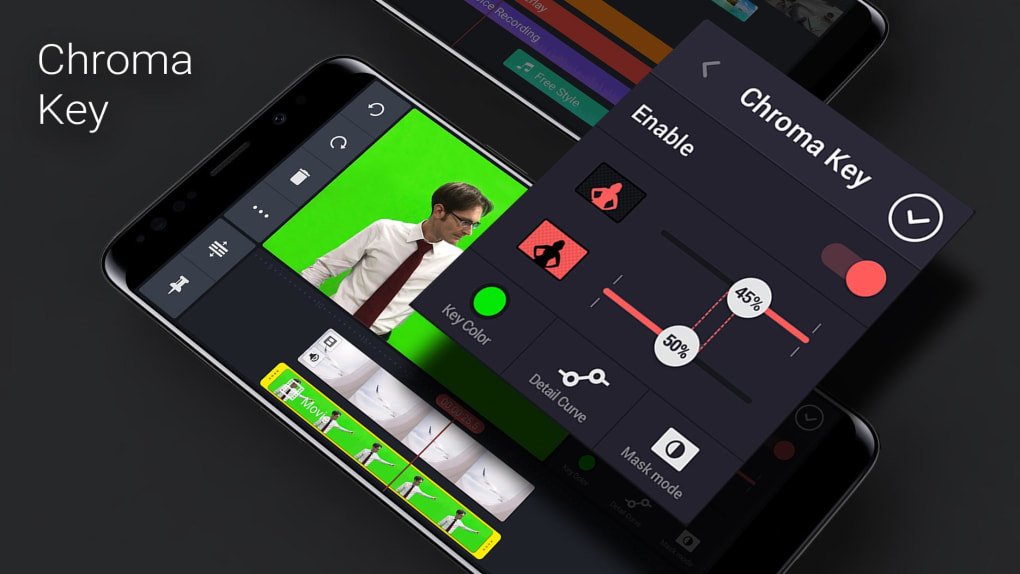
Chroma key in KineMaster removes a solid-color background from footage and replaces it with a different image or video. It sits inside the layer tools and works better than most people expect from a phone app.
The quality depends almost entirely on lighting. With an evenly lit green screen, the edge detection is clean and the composite looks acceptable for YouTube or social content. With uneven lighting, shadows create variation in the green channel and you get a visible fringe around the subject. Dialing in the color threshold manually helps, but there is a ceiling to how much correction is possible.
For anyone with a proper green screen setup and consistent lighting, this feature produces usable output. For a bedsheet-and-phone-lamp setup, results will be inconsistent. Either way, having it available at all in a mobile app is worth noting.
Audio tools: more depth than most people use
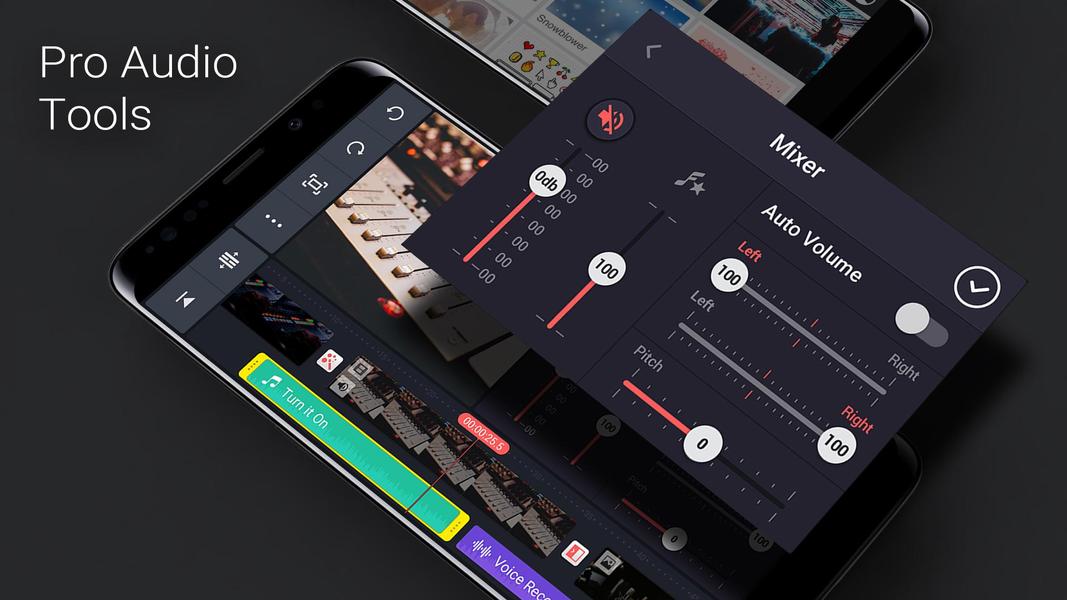
The audio side of KineMaster is the section most people do not fully explore. Beyond the basic volume slider, there is a multi-track audio mixer, a volume envelope for drawing gain changes across a clip, pitch control, reverb, bass adjustment, an equalizer, and a voice changer.
The volume envelope is the most practically useful of these. It lets you reduce a background music track during a spoken section without cutting the track entirely, which is the standard approach in any decent YouTube video. The control handles are small on a phone screen and require some patience to place accurately, but the output is indistinguishable from what a desktop editor would produce.
Recording a voiceover directly inside the app using the Voice layer is straightforward. The audio from a reasonably quiet room and a mid-range Android device was clean enough to use without any additional processing. Not studio quality, but clean enough for the context.
Export options and the watermark question
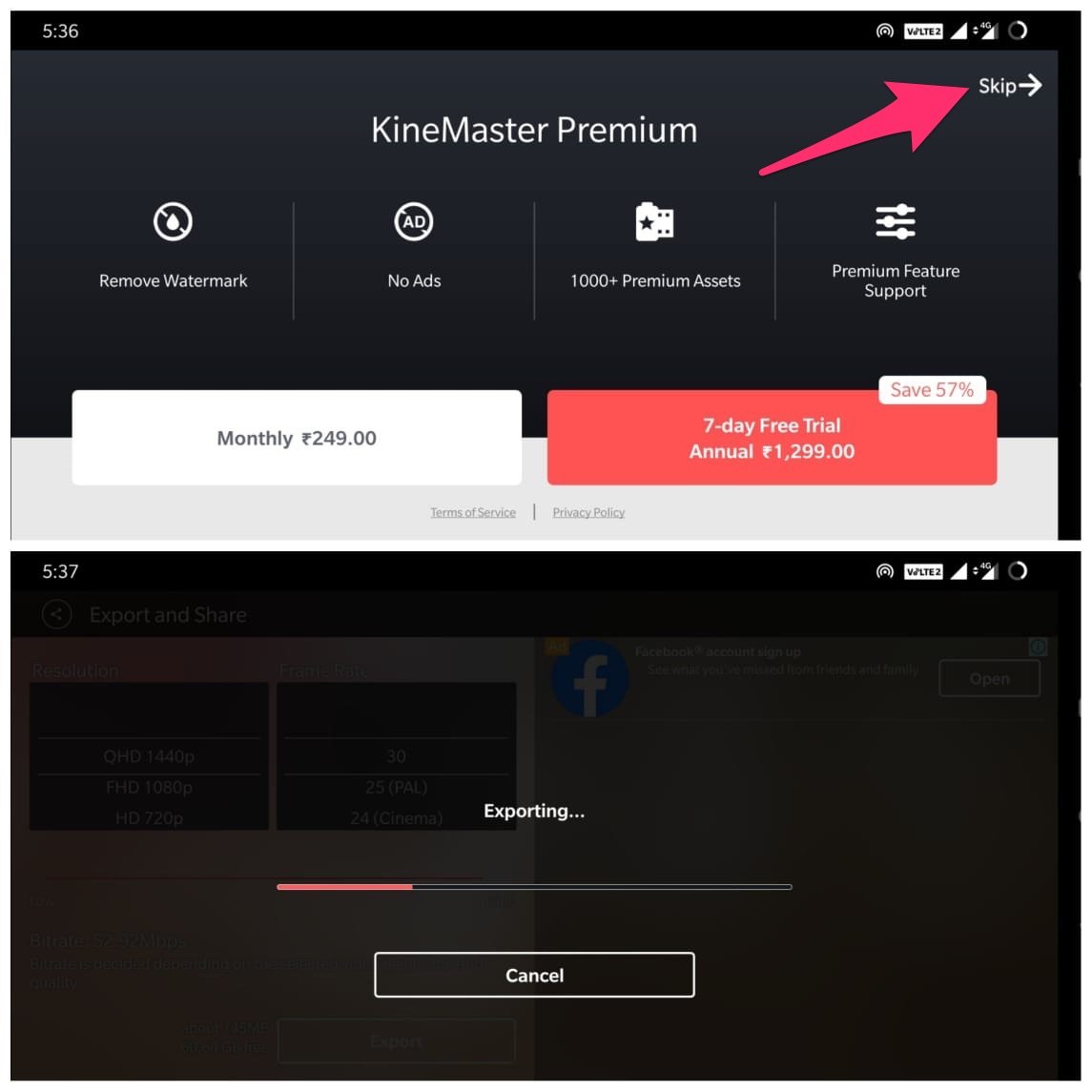
The free version of KineMaster puts a watermark on every exported video. That is the central trade-off of not subscribing. All core editing tools remain available on the free tier, including the timeline, layers, audio controls, and effects. The finished video just has the KineMaster logo on it.
Premium removes the watermark, removes ads, unlocks the full asset library, and includes 10GB of KineCloud storage for backing up and syncing projects across devices. Pricing varies by region. Based on current listings, the annual plan works out to roughly $4.33 per month billed upfront. The monthly rolling plan runs higher. Check the app directly for your local pricing before subscribing.
Export resolution goes from SD 540p up to 4K 2160p, with frame rate and bitrate adjustable before you start the export. A two-minute video at 1080p finished exporting in under a minute on a mid-range Android. Once done, the video appears in the right panel of the editor and can be shared directly to YouTube, Instagram, WhatsApp, Telegram, or any other app on your phone without switching contexts.
The asset store
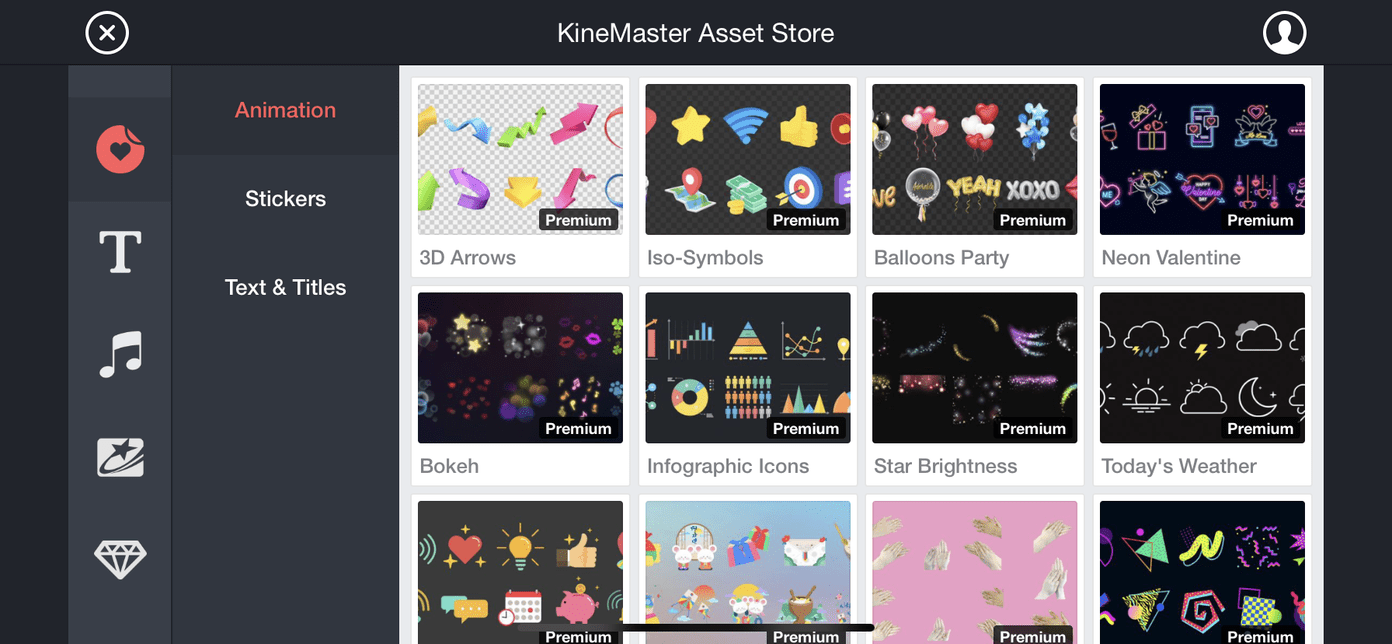
The store inside KineMaster has a larger free section than first impressions suggest. Transitions, text styles, overlays, royalty-free music tracks, and animated sticker packs are available without a subscription. The quality is uneven but there is enough genuinely usable material to avoid looking like every other video made from default settings.
Premium unlocks over 1,000 additional assets and the library updates regularly. The store feels less like a one-time purchase and more like a subscription in itself, which aligns with how KineMaster positions its premium tier.
Real-time editing and color tools
KineMaster lets you record video directly inside the app and apply edits during the recording in real time. A second audio or video layer can be added while the primary clip is still being captured. For fast-turnaround social content, this eliminates the usual record, exit, import, edit cycle.
The color panel covers brightness, saturation, contrast, warmth, and basic color correction. The controls are not deep by desktop standards, but they are sufficient for the most common phone editing problem: matching the look of two clips shot in different lighting conditions. A few seconds with the warmth and saturation sliders usually gets them close enough.
Our Rating – 4.4/5
Android (Play Store) | iOS (App Store)
Who this app actually makes sense for
KineMaster is not the fastest route to posting a single clip. If that is all you need, there are lighter tools for it. What KineMaster offers is a ceiling that most mobile editors simply do not have: proper multi-layer timelines, chroma key, audio envelopes, 4K export, and enough control over every element that the phone stops feeling like a compromise.
The watermark on the free tier is a real limitation for anyone building a public channel. For learning the workflow, finishing personal projects, or deciding whether the app fits your needs before spending anything, the free version covers everything that matters.
After a few weeks with it, I stopped reaching for my laptop for short-form video work. That is probably the clearest way to put it.


Wellcome
Kinmaster