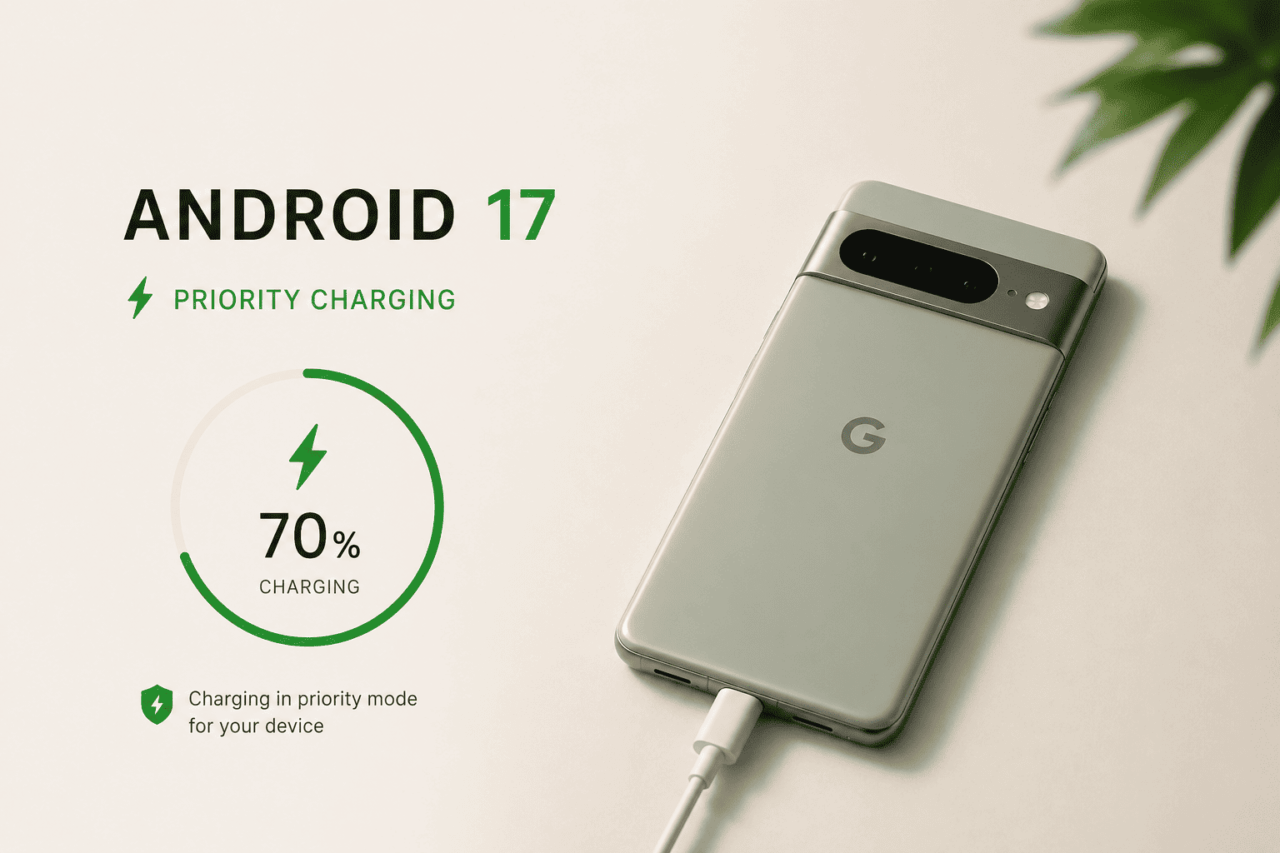
Charging speed on Android has always been a hardware conversation. The charger wattage, the cable, the battery chemistry. What Android 17 adds is something different: a software layer that gets out of the way. Android 17 Priority Charging pauses background CPU processes during a charge session so the phone is not competing with itself for power. It is not a new charger. It is the OS clearing the road.
TL;DR: Android 17 Priority Charging works by suspending non-essential background tasks when you plug in, directing more power toward the battery rather than splitting it with active CPU processes. It requires a charger capable of at least 30W to activate. Early beta testing suggests modest real-world gains rather than dramatic speed improvements. It is most useful when you need a quick top-up under time pressure.
What Priority Charging actually does
When you plug your phone in, the CPU does not stop working. Background app sync, system housekeeping, app updates, location polling — all of it continues drawing power while the battery is trying to absorb charge.
Priority Charging detects that charging has started and suspends non-essential background operations, freeing up more of the power coming in for the battery itself.
Google confirmed the feature first appeared in Android 17 Beta 3 build notes. Tech Advisor’s coverage described it as pausing background operations that keep the CPU busy, with the goal of absorbing available power more quickly.
The feature requires a charger with at least 30W output to trigger. Below that threshold, the phone charges normally.
It is worth being precise about what this is not. Priority Charging does not increase the wattage your charger delivers. It does not change the charging curve or bypass thermal limits.
If your phone or charger caps out at a certain speed, Priority Charging cannot exceed it. What it can do is reduce the amount of power the phone bleeds into other tasks while charging is happening.
Which phones will support it and from when
Priority Charging is a system feature tied to Android 17, so it will arrive on Pixel 6 and newer devices with the stable June 2026 release. Pixel phones ship with 30W charging support from the Pixel 6 generation onward, so the hardware threshold should not exclude any supported device.
For Samsung, OnePlus, Motorola, and Xiaomi users, the feature will arrive whenever those brands ship their Android 17-based builds later in 2026.
Samsung Galaxy S25 and S26 models support 45W charging, OnePlus 13 and OnePlus 15 support 80W and 100W respectively, all well above the 30W threshold, so Priority Charging should activate on those devices once their software updates land.
Whether each OEM implements the feature as Google designed it, or adjusts it within their own charging management systems, remains to be confirmed.
How much of a difference does it actually make
This is the honest part. Priority Charging is not going to halve your charge time. The background tasks it suspends account for a real but limited share of total power draw during charging. If your phone typically charges from 20% to 80% in 40 minutes, you might shave a few minutes off that under good conditions. Exact numbers from controlled testing are not yet available as of May 2026, because the feature is still in beta.
Tech Advisor flagged it as an interesting concept worth watching. The most meaningful scenario is a short charge under pressure, like a 15-minute top-up before leaving the house.
Squeezing an extra few percent into that window is genuinely useful even if the absolute speed gain sounds modest. Think of it less as a charging upgrade and more as a battery absorption optimizer.
There is also a secondary benefit that is easy to overlook. By pausing aggressive background activity, Priority Charging may reduce heat generated during a charge session. Excess heat during charging accelerates long-term battery degradation. A cooler charge is a healthier one, even if the speed difference is small.
How it fits with Android 17’s other battery changes
Priority Charging sits alongside the app memory limits introduced in Android 17 Beta 4, which cap how much RAM individual apps can hold to prevent excessive background resource use.
Together these two changes push in the same direction: reducing the cost of background processes on overall performance and battery health.
Android already has Adaptive Battery, introduced in Android 9, which learns which apps you use regularly and restricts background activity for the rest.
Priority Charging is a more targeted version of that principle, applied specifically to the charging window. The two features complement each other rather than overlap.
If you have a Pixel and tend to charge in short bursts rather than overnight sessions, Priority Charging is the Android 17 feature most likely to show up in your day in a way that matters. The scenario of needing 10 more percent before a meeting and not getting it is one most people have lived. This is a quiet fix for exactly that moment, and it requires no setup at all.
The bottom line
Android 17 Priority Charging is a practical improvement for anyone who charges their phone in short bursts. It needs a 30W or faster charger to activate, works at the system level without any user setup, and lands on Pixel devices with the stable June 2026 release.
Exact speed gains from independent testing are not yet published, but the logic is sound: if the CPU is not consuming power it does not need during a charge, more of that power goes into the battery. That is a reasonable trade, and the Android 17 feature set is better for having it.