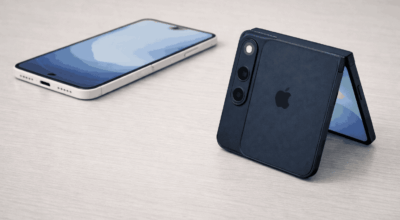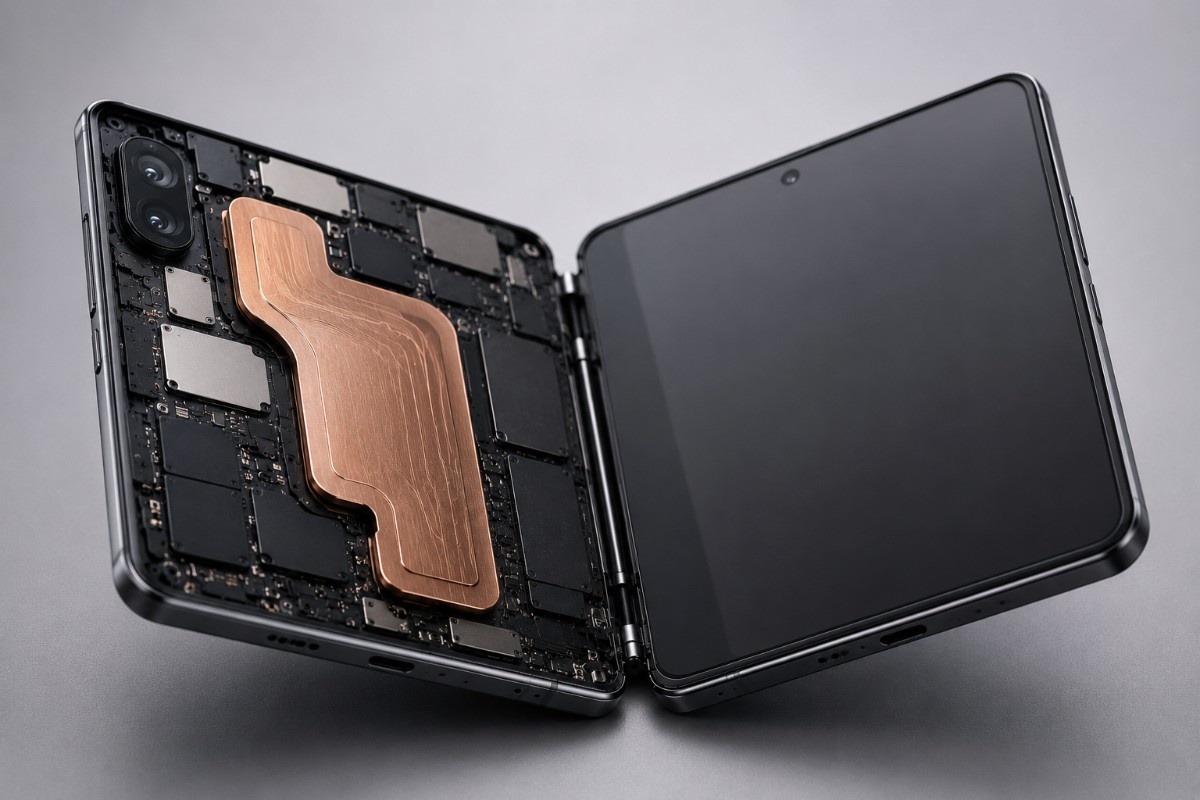
Apple is fitting a vapor chamber into the iPhone Fold Ultra, a phone that unfolds to just 4.5mm thin, according to a new post from Weibo leaker Fixed Focus Digital published June 1, 2026. It is the first time any leaker has attributed that specific thermal feature to the foldable. It also reframes a device that has spent months defined by what it is giving up.
The iPhone Ultra has no Face ID, no telephoto lens, no MagSafe, and no physical SIM slot. The vapor chamber leak is the first detail in weeks that adds something rather than removes it, and what it adds matters for anyone who has watched thin iPhones struggle under sustained load.
TL;DR: Weibo leaker Fixed Focus Digital confirmed a vapor chamber cooling system inside the iPhone Ultra on June 1, 2026. The iPhone Air, which is a similar thickness, does not include one. Apple introduced vapor chambers in the iPhone 17 Pro last year and claimed 40% better sustained performance versus the graphite systems in earlier Pro models. The iPhone Ultra is still on track for a September 2026 announcement alongside the iPhone 18 Pro.
What the iPhone Air comparison tells you

The iPhone Air launched without a vapor chamber. Apple kept costs and complexity down on a phone it positioned as a thin daily driver for most users.
The iPhone Ultra is thinner than the Air when unfolded, yet Fixed Focus Digital says Apple is going in the opposite direction on thermals, describing the performance as “quite impressive” and noting that Apple is “really going all out” with the thermal engineering.
That framing is significant. A vapor chamber is not a default feature in Apple’s lineup. It arrived on the iPhone 17 Pro last year as part of a full thermal redesign, replacing graphite pads with a sealed plate that circulates deionized water to pull heat off the chip and spread it across the aluminum frame.
Apple’s own claim was a 40% improvement in sustained performance under demanding tasks. Prior to that, the iPhone 15 Pro and 16 Pro both drew criticism for throttling under load.
Putting that same system inside a foldable, where the chassis is split across two halves joined by a hinge, is a more complex engineering problem than fitting one into a standard slab phone.
Why foldables have always had a cooling problem
Every book-style foldable divides its internals across two panels. The processor and battery have to share space with the hinge mechanism and the second half of the display stack. That leaves less room for thermal management components than a standard phone chassis provides, and it means heat has fewer direct paths out of the device.
Samsung’s Galaxy Z Fold 7, now in its seventh generation, manages this through a combination of a graphite thermal interface and a relatively thicker folded profile at around 12mm.
The iPhone Ultra’s leaked folded thickness is 9.23mm according to renders shared by yeux1122 on Naver in April 2026. That is meaningfully thinner, which leaves even less room for dissipation, making the vapor chamber claim notable.
Fixed Focus Digital’s post also pushes back on earlier framing from Weibo leaker Instant Digital, who in May attributed the iPhone Ultra’s production difficulties primarily to hinge reliability failures under repeated stress testing.
Fixed Focus Digital says the hinge is not the main bottleneck and that surface-mount technology yields at the pre-assembly stage are the more pressing manufacturing challenge. The two accounts are not reconciled, and both leakers have track records on Apple hardware.
Where the production timeline stands right now
DigiTimes reported in April that mass production had slipped from June to August 2026, a delay of roughly one to two months. That report maintained that a fall launch remained on track.
Bloomberg’s Mark Gurman confirmed in April that the iPhone Ultra is still scheduled for Apple’s normal iPhone launch window alongside the iPhone 18 Pro and Pro Max, and called a Nikkei Asia report suggesting a 2027 delay “off base.”
| Feature | Detail |
|---|---|
| Inner display | 7.8 inches |
| Outer display | 5.5 inches |
| Chip | A20 (TSMC 2nm) |
| Modem | Apple C2 |
| Rear cameras | Two 48MP (wide + ultrawide, no telephoto) |
| Biometrics | Touch ID (side button, no Face ID) |
| Thermal system | Vapor chamber (per Fixed Focus Digital, June 1 2026) |
| Folded thickness | 9.23mm (yeux1122, April 2026) |
| Unfolded thickness | 4.5mm |
| Starting price | Above $2,000 (Ming-Chi Kuo estimate: $2,000 to $2,500) |
| Expected announcement | September 2026 |
| Mass production start | August 2026 (revised, per DigiTimes) |
Supply analyst Ming-Chi Kuo has separately warned that even if the September announcement holds, yield and ramp-up challenges could keep supply tight through the end of 2026. He drew a parallel to the iPhone X, which Apple announced on time but which many customers could not actually buy until weeks or months after launch.
What this means before you decide to buy
The vapor chamber detail does not resolve any of the iPhone Ultra’s confirmed trade-offs. The telephoto lens is still absent. Face ID is still replaced by side-mounted Touch ID. MagSafe is still out. The starting price is still expected to clear $2,000.
What the vapor chamber changes is the sustained performance picture. A phone that throttles under load on a 7.8-inch display during video editing, gaming, or long AI processing tasks would be a harder sell at that price point. If Fixed Focus Digital’s assessment holds up, the iPhone Ultra is at least solving the thermal problem that has tripped up thinner phones before it.
The next concrete milestone is mass production, now planned for August. If that holds, Apple has roughly six weeks before its typical mid-to-late September on-sale window. Fixed Focus Digital’s post closed with a note that further positive news on the device is expected in the coming days.