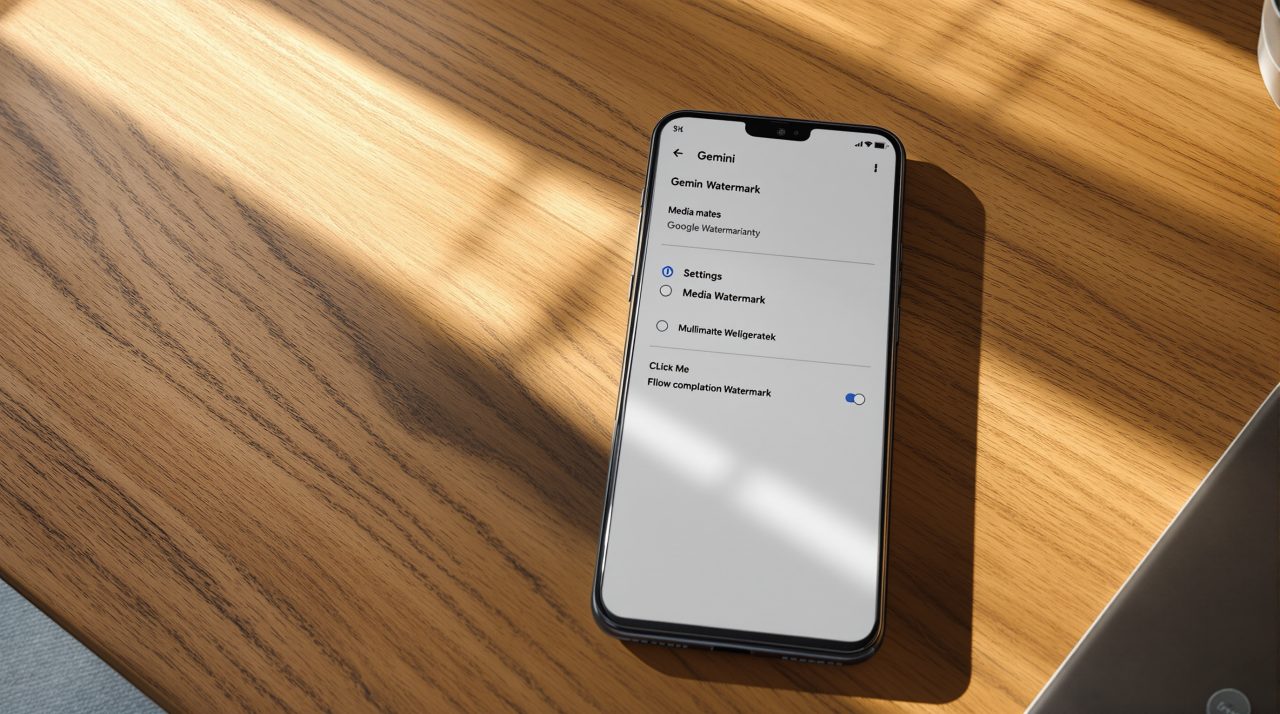
Google is letting Gemini users hide the small spark icon that marks images, videos, and songs as AI generated. Josh Woodward, Google’s VP for Gemini, confirmed the change in a post on X on August 14, 2026, describing a new Media Watermark toggle rolling out across the Gemini app and Google’s Flow video editor this week. The Gemini watermark toggle only removes the visible mark. SynthID, the invisible signal embedded in every file, and the C2PA metadata standard stay in place no matter what you choose. For anyone building slide decks, social posts, or client work with Nano Banana images or Omni video, that is one less visual clue giving away how the file was made.
TL;DR: Gemini now lets you turn off the visible spark watermark on images, videos, and songs made with Nano Banana, Omni, and Lyria. The invisible SynthID signal and C2PA metadata stay embedded regardless, so Gemini and Search can still confirm a file’s AI origin. The setting is not available where local law requires visible AI labels. It is live in Gemini and Flow now, with Search support coming next.
The Gemini watermark toggle only touches the visible mark
The change lives in a new settings menu called Media Watermark. On the web, it sits behind the gear icon in the bottom-left corner. On mobile, it follows the same path inside the Gemini app.
Flip it off and the small spark icon disappears from images made with Nano Banana, video made with Omni, and songs made with Lyria. Flip it back on, which stays the default behavior, and the icon returns. Nano Banana already competes with a wave of free AI image generators, and a cleaner corner makes Gemini’s output easier to mistake for something shot on a camera in that crowded market.
Woodward framed the update as a balance between creative control and safety. Visible watermarks make sense on a quick social post. They get in the way on a client deck or a printed poster, where a stray logo in the corner reads as sloppy, not honest.
| Product | Visible watermark can be turned off | Rollout status |
|---|---|---|
| Gemini app (images, video, audio) | Yes | Live, rolling out over coming days |
| Google Flow (video editor) | Yes | Live |
| Google Search | Not yet | Coming soon |
| Countries requiring visible AI labels by law | No | Not available |

SynthID and C2PA are the part Google is not turning off
SynthID is the invisible signal Google embeds in every image, video, and audio clip Gemini produces. It survives screenshots, crops, and format conversions, and Google has said the technology has now been applied to more than 10 billion pieces of content.
C2PA metadata works differently. It is an industry provenance standard, backed by companies including Adobe and Microsoft, that records where a file came from directly inside its data rather than on its surface.
Neither layer has an off switch. Anyone can still run a file through Gemini or Google Search to check whether it was AI generated, even with the visible spark icon gone. Google is also open sourcing a library called Credentio, which lets developers build that same C2PA verification directly into their own apps.
The timing lines up with Anthropic’s watermark backlash
Google announced the toggle two days after Anthropic began watermarking text generated by Claude to meet new EU rules. That rollout did not go smoothly.
Some Claude users complained the watermark could flag their writing as AI generated in jobs or classes where that carries real consequences. Google’s approach sidesteps that specific complaint by making the visible mark optional while keeping the invisible one mandatory either way.
The two companies are solving different problems with the same word. Anthropic is labeling text in a way a person can read. Google is labeling media in a way only machines are meant to notice, at least once the visible layer gets switched off.
What to actually remember before you flip the toggle
Turning off the visible watermark does not make a Gemini image, video, or song untraceable. It just removes the label a casual viewer would notice first. This fits Google’s broader plan to push Gemini Intelligence into daily use across phones, search, and creative tools, one feature update at a time.
The setting also is not universal. Google has said it will not appear in countries where local law requires visible AI labeling, and there is no published list yet of exactly which markets that covers.
The rollout reaches Gemini and Flow first, with Search support coming afterward. Anyone editing AI media for public use, not just casual chats, should expect the option to show up gradually rather than everywhere at once.