The prompt was identical. “Create a small ping pong game .html for me to play on the browser.” Two models, same session, a few minutes apart.
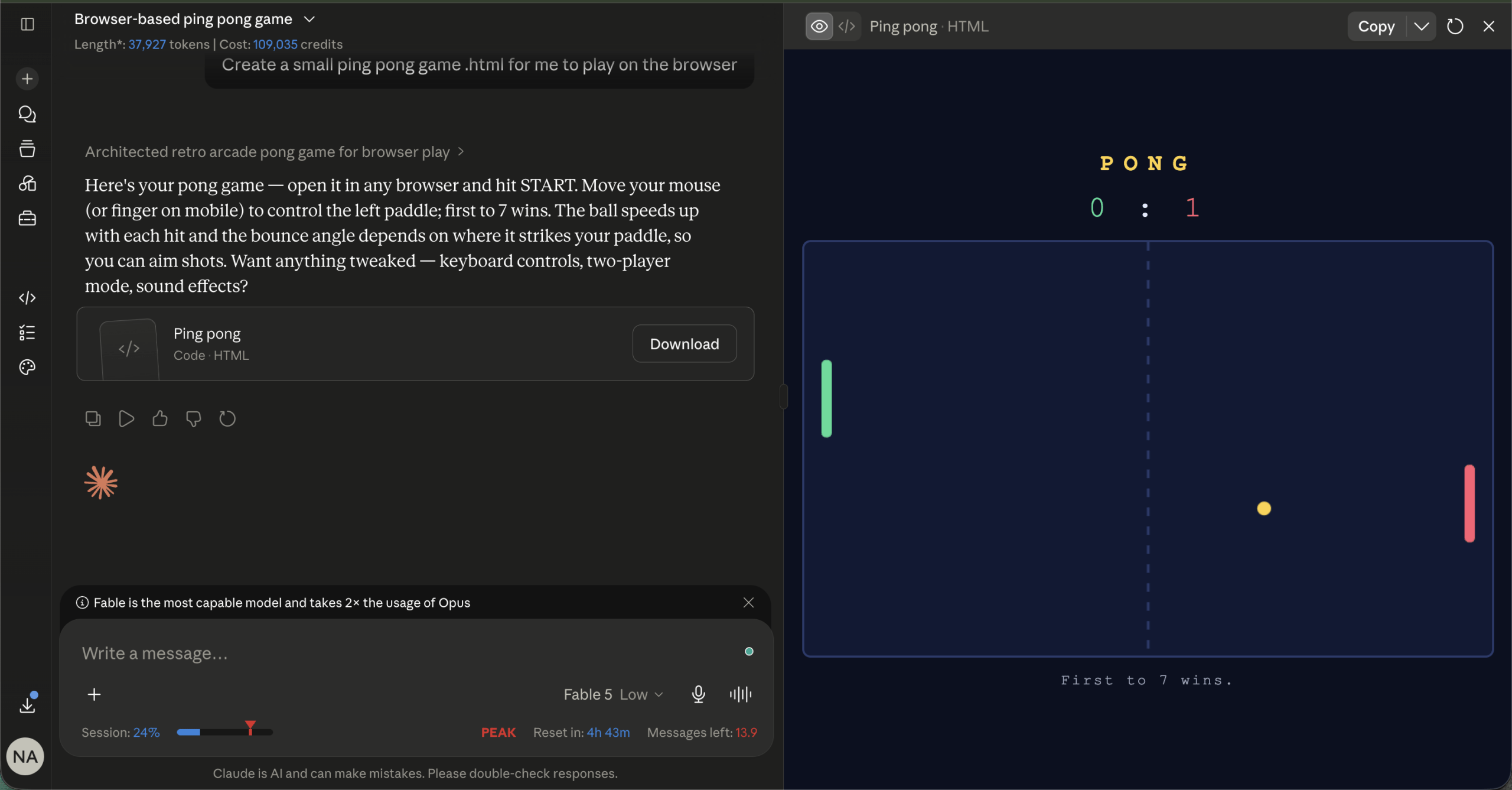
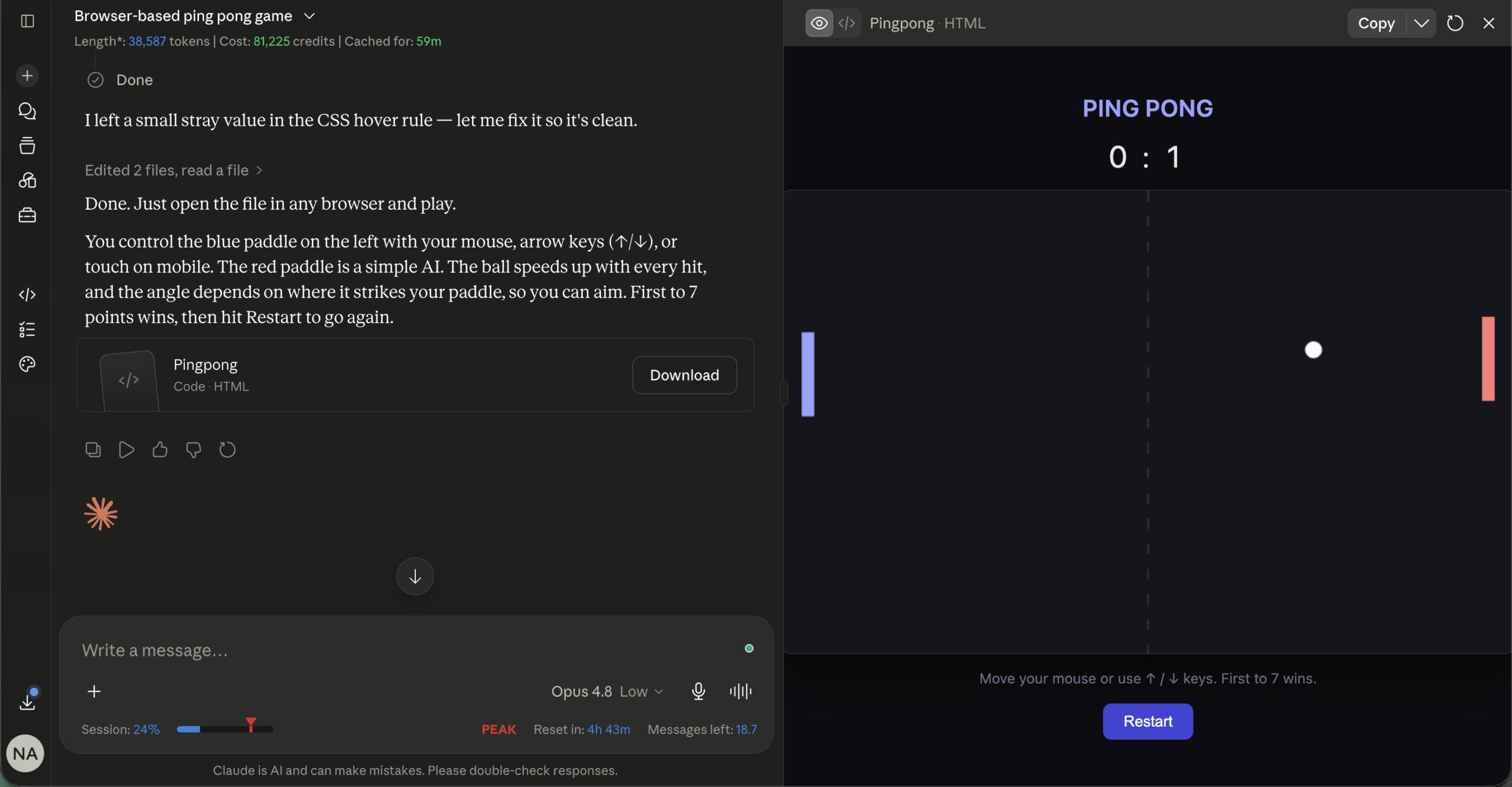
The game Claude Fable 5 built had a dark navy background, a green player paddle, and a yellow ball that felt like something from a polished browser demo. Opus 4.8 built something that also worked: blue and red paddles, tighter layout, classic arcade colors. Neither game was wrong. Fable 5 just looked designed.
That gap is small enough to dismiss. It also turned out to be diagnostic.
TL;DR: Claude Fable 5 launched on June 9, 2026 as the first publicly available Mythos-class model from Anthropic. It scores 80.3% on SWE-Bench Pro against Opus 4.8’s 69.2%, costs twice as much per token, and auto-routes security and biology queries to Opus 4.8. In real-world testing, the session drain is measurable and begins with the first task.
What Claude Fable 5 actually is
Claude Fable 5 is the first public version of Anthropic’s Mythos-class model, released on June 9, 2026. The Mythos line was originally kept entirely off-limits because Anthropic concluded it was too capable in cybersecurity to release without restriction. Project Glasswing, a controlled rollout to cyber defense organizations, was the only path to access since April.
Fable 5 uses the same underlying model as Mythos 5 but wraps it in classifiers that route high-risk queries to Claude Opus 4.8 instead. The benchmark gap is meaningful: Fable 5 scores 80.3% on SWE-Bench Pro against Opus 4.8’s 69.2%, and is the first Claude model to exceed 90% on Hex’s long-running analytical benchmark. According to Anthropic’s announcement, both Fable 5 and Mythos 5 are priced at $10 per million input tokens and $50 per million output, exactly double the standard Opus 4.8 rate.
The interface on claude.ai reflects this from the first interaction. Selecting Fable surfaces a notice that it “takes 2x the usage of Opus,” and the session panel tracks consumption visibly across every task.
| Feature | Claude Fable 5 | Claude Opus 4.8 |
|---|---|---|
| SWE-Bench Pro score | 80.3% | 69.2% |
| Price per 1M tokens (input / output) | $10 / $50 | $5 / $25 |
| Session credits used (ping pong build) | 109,035 | 81,225 |
| Tokens used (same task) | 37,927 | 38,587 |
| Messages remaining after task | 13.9 | 18.7 |
| Security fallback to Opus 4.8 | Yes | No |

The visual difference and what it tells you
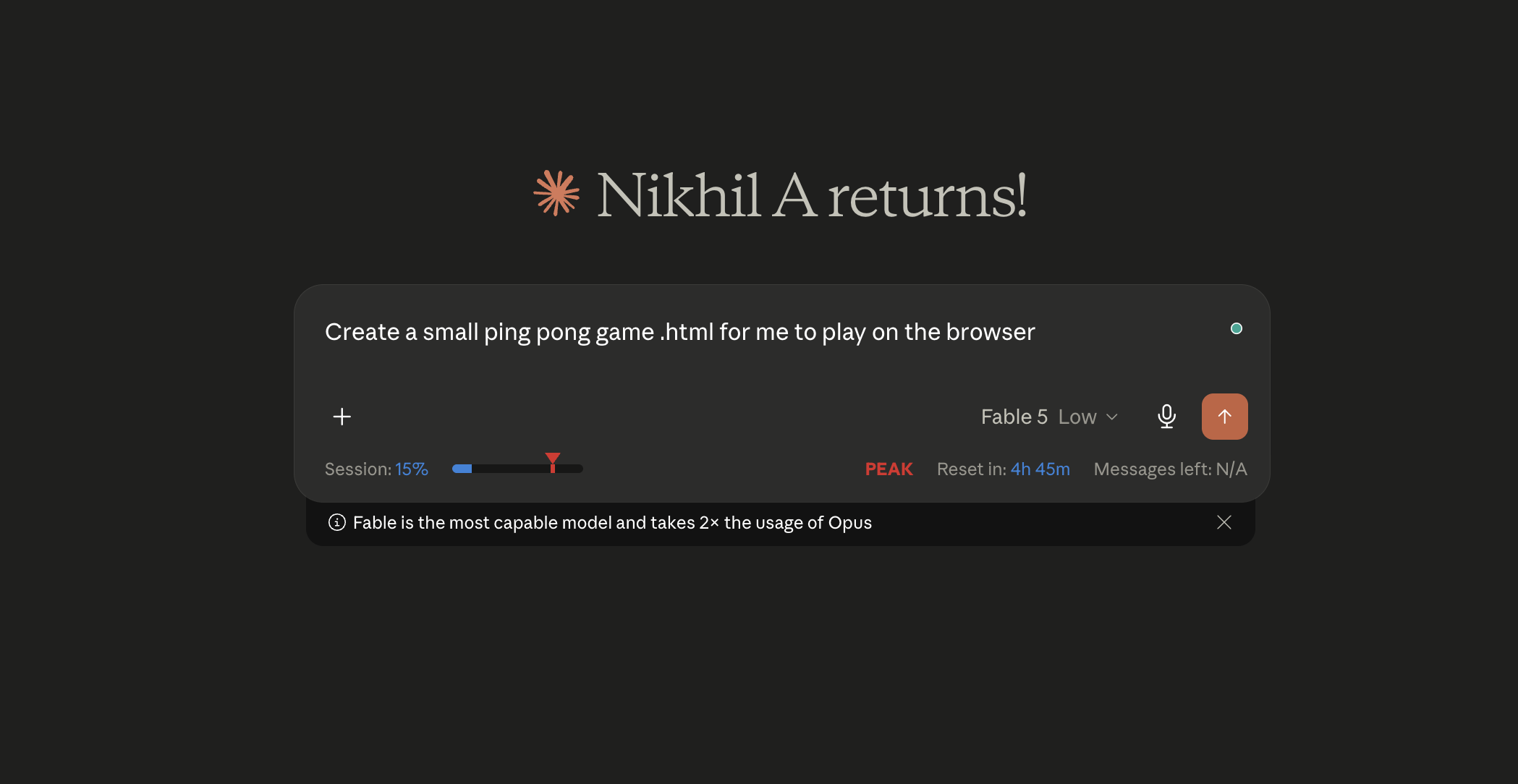
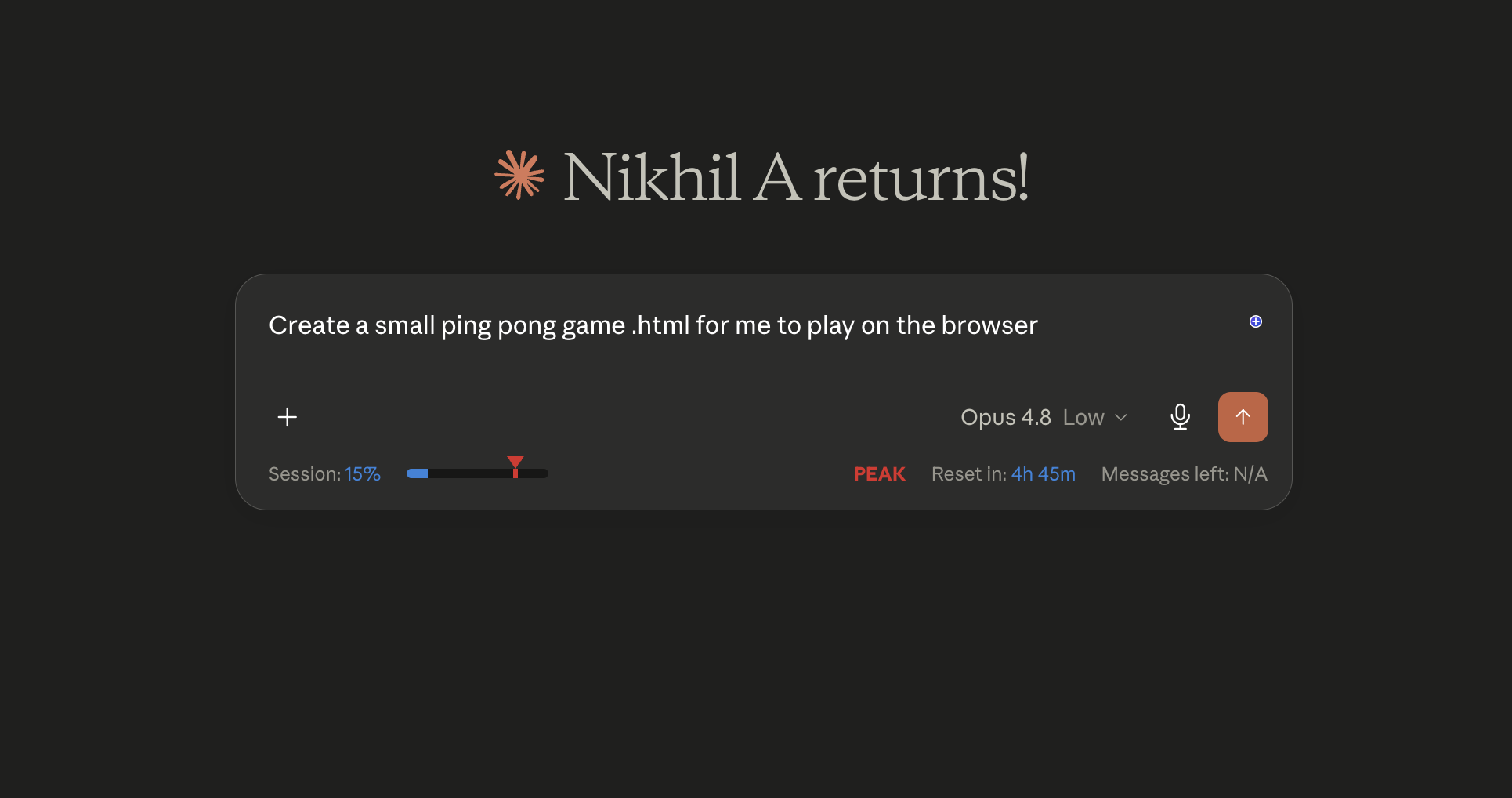
Both games worked. The difference was in how much of the output each model decided unprompted.
Fable 5’s version had a dark navy field, visually distinct paddle colors, and a clean score display. Opus 4.8’s version was functionally complete with a more neutral palette and a tighter arcade layout. Same prompt, two different aesthetic sensibilities. I had to go back and compare both screenshots to confirm they ran identically. The game Fable built looked like a CSS theme had been applied.
Third-party evaluation data backs this up. Genspark ran Fable 5 across its internal benchmarks and reported significantly better performance on UI design and game coding specifically, compared to other frontier models. Anthropic also notes Fable 5 can rebuild a web app’s source code from a screenshot alone, a form of spatial visual reasoning that reflects how the model handles layout, not just syntax.
The gap is not obvious on text tasks. For Claude model output quality comparisons on prose or structured writing, differences between generations are subtle. On anything with a visual layer, the gap starts to show clearly.
The security fallback you will hit eventually
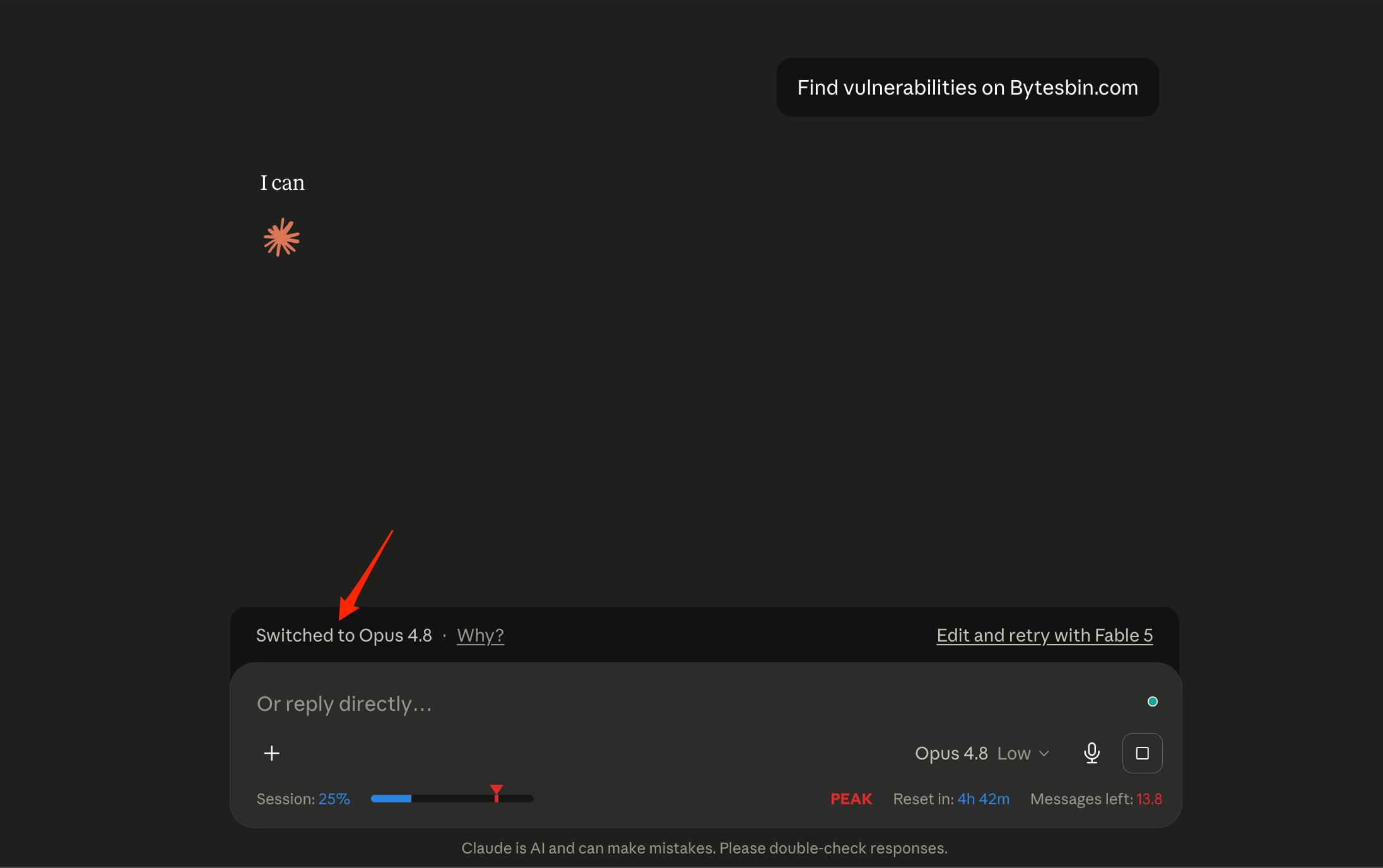
Ask Fable 5 about a security vulnerability on a real domain and the interface changes without ceremony. A small banner appears: “Switched to Opus 4.8.” An option to edit and retry with Fable 5 sits alongside it. The response that follows comes from Opus, not the model you opened the session with.
The first time it happens, it reads like a failure mode. It is not.
Anthropic built the fallback into Fable by design. Cybersecurity, biology, chemistry, and model distillation queries are intercepted by classifiers before Fable 5 ever generates a response. Anthropic reports the fallback triggers in fewer than 5% of sessions on average. External red-teaming over more than 1,000 hours found no universal jailbreak for the model.
The experience makes more sense once you understand what Mythos-class capability in cybersecurity actually means. The classifier is not a limitation. It is the mechanism that made public release possible at all.
The session math in real numbers
The credit numbers from a single coding task are specific enough to matter. Fable 5 used 37,927 tokens on the ping pong build for a cost of 109,035 session credits. Opus 4.8 completed a similar build using 38,587 tokens for 81,225 credits. Token counts were nearly identical. Session credit cost ran 34% higher on Fable.
Messages remaining reflected the same pattern. After the Fable build, 13.9 messages were left in the session window. After the comparable Opus task, 18.7 remained.
If you are already watching your Claude usage limits, Fable 5 will compress that ceiling fast. The 2x pricing at the model level tracks directly into session consumption in practice, and the panel makes it visible in real time.
Speed: the part that does not match the benchmarks
Fable 5 felt slower on single-turn prompts at Low effort. Not dramatically, but the response latency on simple queries was noticeable. At first I thought it was a connection issue. It was not. Opus would return the same prompt faster in the same session window.
The benchmark data points the other way on complex work. Anthropic reports Fable finishes multi-step tasks 25 to 30% faster than Opus with fewer turns, and outperforms Opus on vibe-coding tasks with fewer tokens. The efficiency gain is real on sustained reasoning work, not on quick single-prompt turnaround.
This resolves once you accept that Fable is a different kind of tool from Opus rather than a faster version of the same one. Its cost advantage appears on tasks where Opus would have taken multiple correction turns. For a single-prompt game build, you are paying for capability headroom that the task did not require.

Frequently Asked Questions
Is Claude Fable 5 available to free users?
No. Fable 5 is available on claude.ai for users on consumption-based plans, and via the Claude API, Claude Code, and enterprise infrastructure on AWS, Google Cloud, and Microsoft Foundry.
Why did Claude switch to Opus 4.8 when I asked about security?
Fable 5 automatically routes cybersecurity, biology, and chemistry queries to Opus 4.8. This is a built-in safeguard, not a malfunction. It triggers in fewer than 5% of sessions on average.
Does Fable 5 use more of my Claude usage limit than Opus?
Yes. Fable takes twice the session usage of Opus by design. In real testing, a comparable coding task cost 109,035 session credits on Fable against 81,225 on Opus, with nearly identical token counts.
What is the API model ID for Claude Fable 5?
The API model string is claude-fable-5. It is available immediately on the Claude Platform, AWS, Google Cloud, and Microsoft Foundry.
When Fable 5 earns its cost
Fable 5 earns its cost on long-horizon tasks where Opus tends to lose track over context length or requires multiple correction turns. Multi-document analysis, full app builds from a single prompt, anything where the quality gap between models becomes visible over multiple steps.
The visual output advantage is real on tasks with a design layer. The session cost is real on every task. The model is available today as claude-fable-5 via the API, in claude.ai on consumption plans, and inside Claude Code.
Fable 5 is not a replacement for Opus across all usage. It is a better model for specific categories of work, and a noticeably worse value for everything else. The choice is less about raw capability and more about whether the task you are running benefits from what that capability gap actually buys.