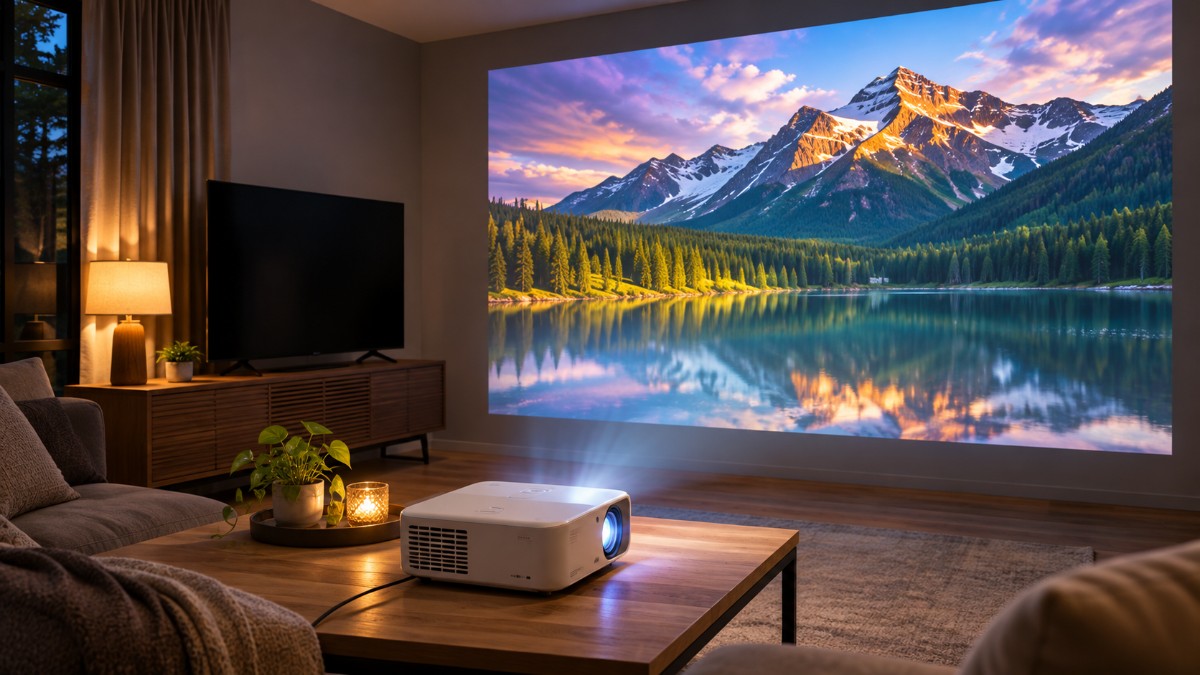
A 65-inch flagship TV runs $1,700 to $2,000 right now, and a projector instead of a TV can look like the obvious way out. The picture gets bigger and the price drops, sometimes by half.
The catch is the room. A projector that looks great at 9pm can look washed out at 2pm with the curtains open.
We compared brand specifications with independent lab measurements for six projectors, and the two do not always match. Where a number comes from a tester, the source is named. Prices are mid-November 2026 snapshots and they move fast.
TL;DR: A projector can replace a flagship TV for roughly half the money or a bit more, but only in a room you can darken. The BenQ TH575 is the value pick for brighter rooms. The Epson Home Cinema 2350 and Hisense M2 Pro are the two 4K style picks to compare. Small portables like the XGIMI MoGo 4 are fun, not TV replacements.
A projector instead of a TV: where the half price math lands
The TV to beat is the 65-inch Hisense UR9 RGB Mini-LED. Best Buy lists it at $1,699.99, Currys in the UK at £1,699 and Best Buy Canada at C$2,499.99.
Half of that lands near $850 to $1,000 in the US, about £850 in the UK and roughly C$1,250 in Canada. Not every projector below gets there, and the table shows which ones don’t.
Black Friday is pushing TV prices down further, so check our Black Friday TV deals page first. A projector only wins if the TV you are replacing stays expensive.
What the saved money buys is size, not brightness. The 75-inch UR9 is $2,499.99 at Best Buy, $800 more than the 65-inch, while a projector can fill a 100-inch wall for far less.
How to read projector specs without getting fooled
Brightness comes first, because it decides how much daylight the picture survives. ANSI and ISO lumens follow a standard, while a bare lumens number on a marketplace listing does not.
Even a good number is a best case. Laurent Willen measured the BenQ TH575, rated at 3,800 ANSI lumens, at 1,766 to 2,775 lumens in its main modes and 1,214 lumens after calibration.
Resolution is the second trap. A “4K” projector often has a 1080p chip that shifts its pixels to draw more detail, and Hisense’s launch release credits the M2 Pro with 2.07 million micromirrors, the pixel count of a 1080p chip.
Contrast is the third. Epson’s 16,000:1 figure for the Home Cinema 1080 assumes the auto iris is on and the lamp is at normal power, so a typical scene looks flatter.
Single chip DLP projectors can also show a rainbow effect, brief colored flashes that some people never notice and others catch in the first white credit on black. Epson’s three chip LCD design avoids it.
The six projectors at a glance
Prices below are US snapshots from brand and retailer pages. Check the live price before ordering.
| Projector | Resolution | Rated brightness | Type | US price seen |
|---|---|---|---|---|
| BenQ TH575 | 1080p native | 3,800 ANSI lumens | Brighter room | $749 at Best Buy, some listings lower |
| Epson Home Cinema 1080 | 1080p native | 3,400 ISO lumens | Brighter room | Discontinued; $749.99 MSRP, refurbished only at Epson |
| Epson Home Cinema 2350 | 1080p chips, 4K PRO-UHD shifting | 2,800 lumens (color and white) | Home cinema | $1,499.99 at Epson, $1,099.99 to $1,399.99 at Best Buy |
| Hisense M2 Pro | 4K via pixel shifting | 1,300 ANSI lumens | Home cinema | $997.49 to $1,299.99 |
| XGIMI MoGo 4 | 1080p, from a 540p chip per Expert Reviews | 450 ISO lumens | Portable | $479 at XGIMI ($499 list) |
| Samsung The Freestyle 2nd Gen | 1080p | 230 ANSI lumens | Portable | $799.99 at Samsung |
Two lamp projectors for brighter living rooms
BenQ TH575

The BenQ TH575 is one of the more affordable ways to get a big 1080p picture from a traditional lamp projector. BenQ rates it at 3,800 ANSI lumens with a native 1080p DLP chip and 16.7 ms input lag at 1080p and 60Hz.
It is a plain display. Best Buy’s spec list shows no HDR and no smart platform, so a streaming stick or console does the rest.
Fan noise is the quiet cost. Willen measured about 40 dB at one meter, which is audible in a silent scene.
Best Buy listed it new at $749, and some sellers go lower. Check the model letters, since the TH575i adds a Google TV dongle and B&H lists it at $649.
Epson Home Cinema 1080 (discontinued)
The Epson Home Cinema 1080 gets its brightness from three 1080p LCD chips, rated at 3,400 lumens, so there is no rainbow effect.
RTINGS found poor contrast across all scenes, no HDR, and input lag that Game mode does not reduce. Daytime sports will hide that, a dark film at night will not.
It is discontinued, so treat it as a bargain hunt, not a current recommendation. Epson now shows only a refurbished unit, out of stock, and its store lists the Home Cinema 1100 at $949.99 with the same 3,400 lumens.
It has no smart platform either, so budget for a stick. Our list of free Roku channels shows what a basic Roku adds.
Two 4K style projectors for dim rooms
Epson Home Cinema 2350
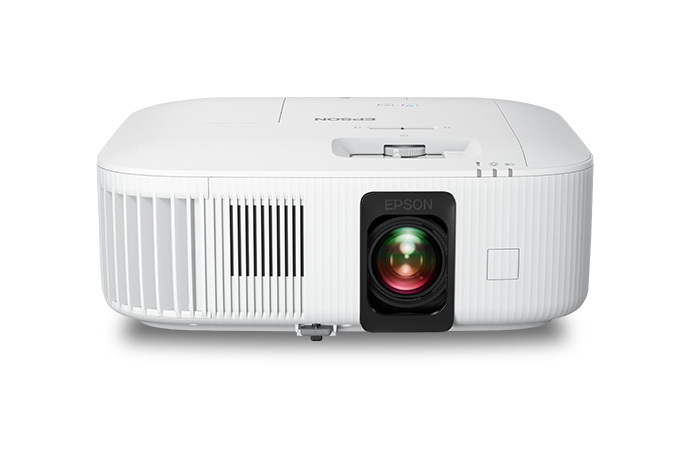
Epson lists the Home Cinema 2350 at 2,800 lumens with 4K PRO-UHD, HDR10 and an Android TV streaming player included.
The 4K label needs context. ProjectorCentral calls it a 1080p native projector that uses pixel shifting to mimic 4K, and it measured input lag between 18 and 26 ms depending on the mode.
TechGearLab measured much higher lag on its own rig, so treat any lag figure as method dependent.
Epson’s store lists $1,499.99 while Best Buy pages have shown $1,099.99 to $1,399.99, so it rewards patience.
Hisense M2 Pro
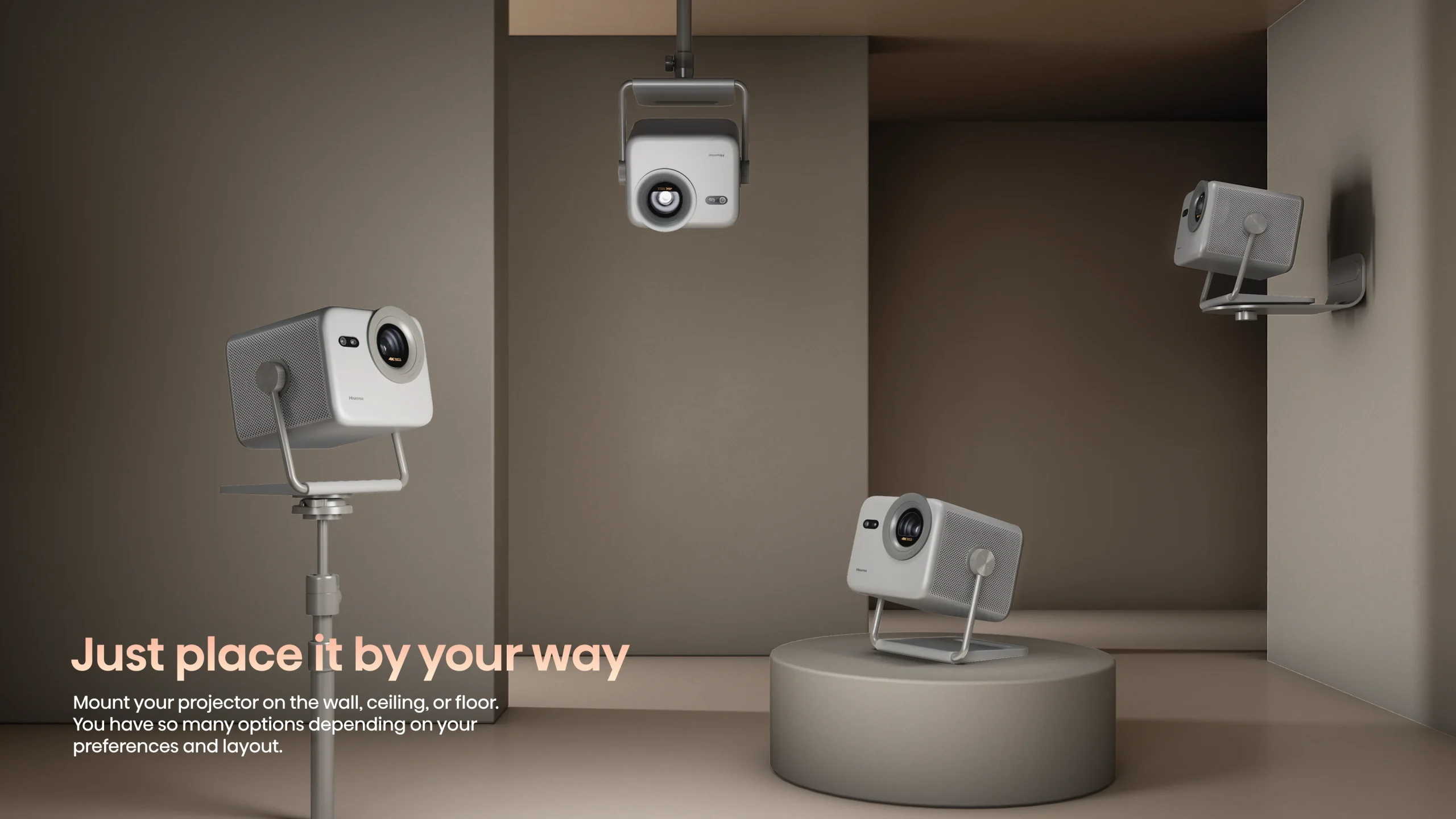
The Hisense M2 Pro is a compact triple laser projector rated at 1,300 ANSI lumens, about a third of the TH575’s rated output. That is why it suits dimmed rooms better than bright ones.
It is sold as 4K, but the micromirror count points to pixel shifting, and Best Buy still lists native 3840 by 2160. Retail listings often repeat the headline claim.
ProjectorCentral measured 27.2 ms of input lag at 1080p and 60Hz against Hisense’s 12 ms claim, which is still responsive.
It runs Hisense’s VIDAA smart platform, so apps are built in.
Hisense’s US store lists $1,299.99 with sale prices from $997.49 to $1,099.99. We could not confirm a UK or Canadian price.
Portable projectors look cheap but behave differently
XGIMI MoGo 4
The XGIMI MoGo 4 is a battery powered 1080p LED projector rated at 450 ISO lumens, and XGIMI’s US store lists it at $479.
Expert Reviews identifies the chip as natively 540p, with pixel shifting making up the 1080p image, and Techreviewer measured about 330 ANSI lumens.
That is enough for a dark room or an evening in the garden, not for daylight. It is pricier in Canada, at C$999.99 to C$1,149.
XGIMI’s spec sheet gives game mode latency of 20 ms with auto keystone off and 56 ms with it on, so that setting matters for console play.
Samsung The Freestyle 2nd Gen
Samsung’s Freestyle 2nd Gen is a 1080p LED projector that CDW’s listing puts at about 230 ANSI lumens, with Tizen built in and a single micro HDMI input.
Samsung US lists it at $799.99, and Samsung UK’s page data shows £399. At 230 lumens it needs a dark room, so it is an evening gadget, not a TV alternative.
The hidden costs of a projector
The projector’s price is not the whole bill. You also need a blank wall or a screen, and a screen’s price depends on its size.
Sound is the next gap. The TH575 has a 10W mono speaker and the Home Cinema 1080 a 2W one, so a soundbar is likely.
Placement matters too. The TH575 has a 1.49 to 1.64:1 throw ratio, and the MoGo 4 needs about 2.66 meters for a 100-inch image.
Lamps wear out. A 6,000 hour lamp lasts about five and a half years at three hours a day, but Epson’s 2350 lamp warranty is 90 days and BenQ’s is one year or 2,000 hours.
A TV skips those extra bills. The UR9 is a Google TV with apps built in, so there is no box to add and no room to darken.
Which projector fits your room
Partly lit room with curtains drawn: the BenQ TH575 offers the highest rated brightness here. It still needs controlled lighting and will not match a TV in direct daylight, and the discontinued Epson Home Cinema 1080 is only worth it if you find one cheap.
Dim room with streaming built in: compare the Epson Home Cinema 2350 and the Hisense M2 Pro, and let the live price decide.
Occasional use in small spaces or outdoors: the MoGo 4 or the Freestyle fits, but you trade brightness for portability.
If you want a bright picture with every light on, the TV still wins, and a 65-inch flagship at these prices is hard to beat.
Frequently Asked Questions
Can a projector really replace a 65-inch TV?
In a dim room, yes. With daylight it struggles, since the 3,800 lumen BenQ TH575 measured no more than 2,775 lumens in its main modes.
Is 4K on a cheap projector real 4K?
Usually it is pixel shifting from a 1080p chip. ProjectorCentral calls the Epson Home Cinema 2350 a 1080p native projector, and the Hisense M2 Pro has 2.07 million micromirrors.
Which projector works best in a bright room?
The BenQ TH575 is rated at 3,800 ANSI lumens, the most here. The discontinued Epson Home Cinema 1080 is rated at 3,400 lumens but has poor contrast.
Do these projectors have streaming apps built in?
The Epson Home Cinema 2350 includes Android TV, the Hisense M2 Pro runs VIDAA, the XGIMI MoGo 4 runs Google TV and the Samsung Freestyle uses Tizen. The BenQ TH575 and Epson Home Cinema 1080 have no smart platform, so you need a stick.
How much cheaper is a projector than a flagship TV?
The 65-inch Hisense UR9 is $1,699.99 at Best Buy. The BenQ TH575 at $749 is under half, the Hisense M2 Pro starts near 60 percent on sale, and the Epson Home Cinema 2350 can be 65 to 88 percent depending on the seller.
What to check before you order
Confirm the live price, the exact model letters and the return window, because projector prices swing more than TV prices. Pixel shifting, HDR and “native” labels also vary by seller.
We could not confirm UK prices for the BenQ, both Epsons or the Hisense M2 Pro, or Canadian prices for most of them, so check live listings.
If a projector wins, the TV you are replacing still has a second life, and our old TV reuse ideas cover what to do with it.
The right choice often comes down to one question: will the room ever be dark enough for the picture you are paying for?