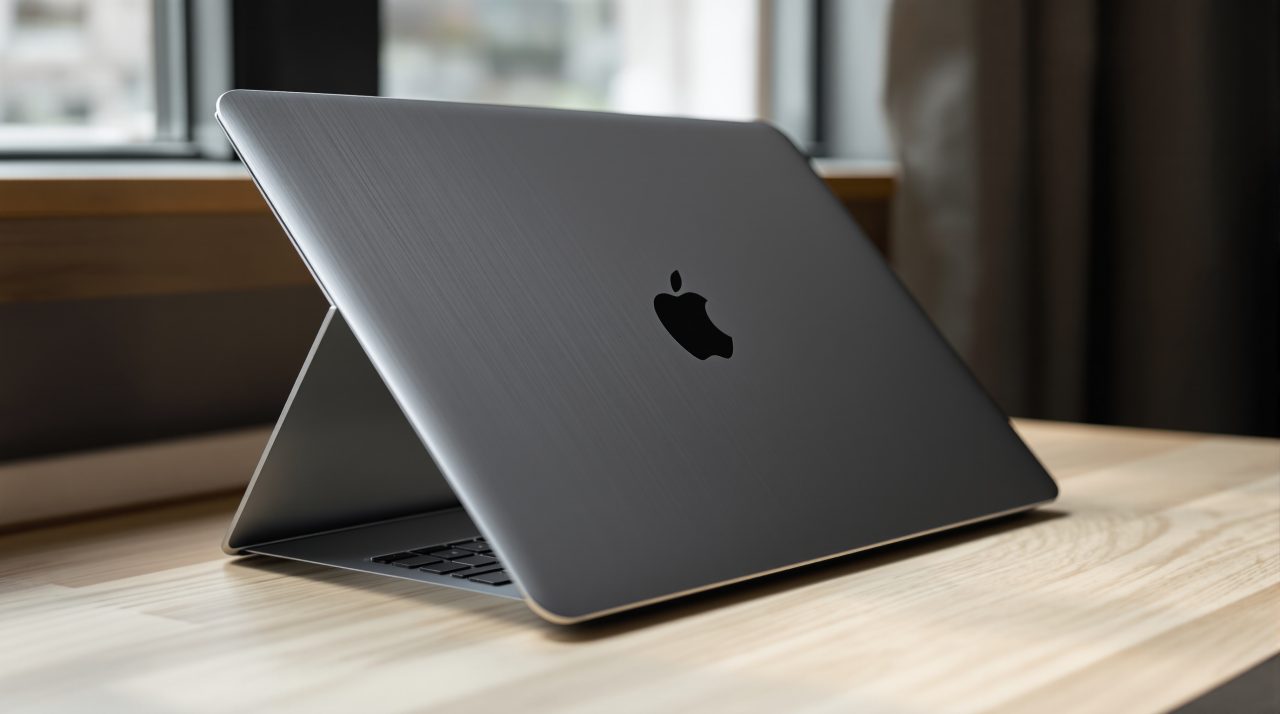
Apple is skipping an entire tier of Mac chips. Bloomberg’s Mark Gurman reported in his Power On newsletter that Apple will release a base M6 chip later this year, but will not build M6 Pro, M6 Max, or M6 Ultra variants at all. The next chips built for serious MacBook Pro and Mac Studio work are M7 Pro and M7 Max, and those do not arrive until late 2027.
For anyone who assumed the usual yearly refresh would eventually bring a faster high-end MacBook Pro, that assumption just broke. The chip most Pro and Max buyers actually care about is skipping a generation entirely, and the reason has nothing to do with cost cutting.
TL;DR: Apple is skipping M6 Pro, M6 Max, and M6 Ultra chips entirely, according to Bloomberg’s Mark Gurman, moving straight to an AI-focused M7 family instead. Only a base M6 chip ships this year, in a new 14-inch MacBook Pro. M7 Pro and M7 Max chips do not arrive until late 2027, roughly 20 months after the M5 Pro and M5 Max chips already shipping today. That gap is longer than any previous stretch between high-end Mac chip generations.
What happens to the M6 Pro chip that never arrives
The base M6 chip lands in a new 14-inch MacBook Pro later this year, and that is where the M6 story ends. Gurman says Apple will not build M6 Pro, M6 Max, or M6 Ultra chips, the tiers that normally define the higher end of the Mac lineup. Instead, Apple is moving straight to M7 chips, starting with a base M7 model in the first half of 2027, followed by M7 Pro and M7 Max chips in the second half of 2027, and an M7 Ultra chip in 2028.
Mac Studio buyers get one more step before this shift. Gurman still expects an M5 Ultra chip in the Mac Studio as early as this year, which means the M5 generation actually outlasts the M6 generation entirely on the high end.
| Chip | Expected timing | Tier |
|---|---|---|
| M5 Pro / M5 Max | March 2026 | Shipping now |
| M5 Ultra | Late 2026 | Mac Studio |
| M6 | Late 2026 | Base only, 14-inch MacBook Pro |
| M7 | First half of 2027 | Base |
| M7 Pro / M7 Max | Second half of 2027 | MacBook Pro high end |
| M7 Ultra | 2028 | Mac Studio, Apple Intelligence servers |
AI is the reason, not the usual chip cadence
Gurman’s own explanation is direct: Apple had been planning major neural processing upgrades for the M7 family, and decided those improvements mattered enough to justify skipping ahead rather than finishing the M6 lineup first. “AI is no longer just another feature Apple’s chips need to support,” he wrote. “It is now shaping how those products are designed and when they are shipped.”
That framing matters more than the missing chip names suggest. Apple has spent a decade shipping a predictable Pro, Max, and eventually Ultra chip within months of the base model. Breaking that pattern to prioritize the M7 family’s AI architecture signals Apple is treating on-device AI performance as something worth delaying a product line for, not a feature to bolt on later.
The real cost is time, not money
Waiting for the next MacBook Pro chip now means waiting until late 2027. Apple’s Pro and Max chips have historically landed 10 to 17 months apart, from the M1 Pro and M1 Max in October 2021 through the M5 Pro and M5 Max in March 2026. The jump from M5 Pro and M5 Max to M7 Pro and M7 Max stretches to roughly 20 months, longer than any gap between Mac Pro tier chips since Apple Silicon began.
That gap is the real headline here, not the missing M6 Pro name. Buyers who need a Mac for demanding video, engineering, or machine learning work are stuck with the current M5 Pro and M5 Max chips for an unusually long stretch, whether they like it or not.
The touchscreen MacBook Pro already worked around this gap
Apple’s confirmed touchscreen MacBook Pro quietly previewed this exact roadmap weeks before Gurman’s Power On newsletter spelled it out. That device reuses the existing M5 Pro and M5 Max chips instead of waiting for M6 Pro silicon that was never actually planned, pairing them with an OLED display and Dynamic Island at a price closer to $4,000 than $2,500.
Reusing M5 Pro and M5 Max chips there was not a shortcut. It was Apple building around a chip gap it already knew was coming. The pattern lines up with a broader trend already reshaping device pricing: AI infrastructure demand pushing up component costs across phones and computers alike, not just chip roadmaps.
What this means for your next Mac purchase
Buy the current M5 Pro or M5 Max MacBook Pro now if serious performance is the goal. There is no M6 Pro coming to wait for, and the base M6 refresh later this year is built for buyers who do not need Pro-level power in the first place.
If a genuine performance jump is worth waiting for, M7 Pro and M7 Max chips in late 2027 are the real target, not anything shipping in the next twelve months. Anyone shopping in between is choosing between hardware that already exists and a wait longer than any previous Mac chip generation gap.