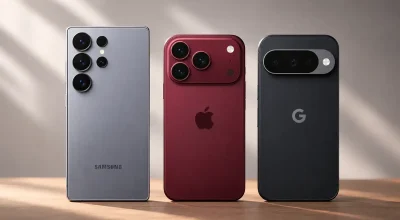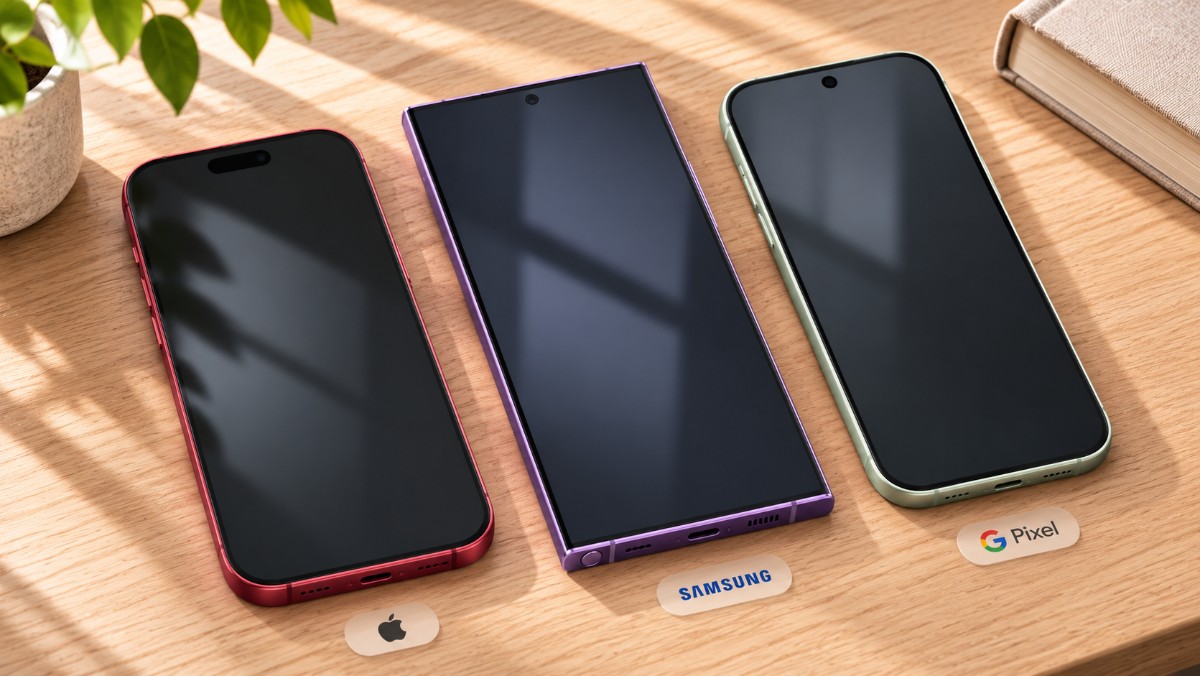
Everyone treats a phone the same way. It rides in a pocket with the keys, lands face down on a desk, gets squinted at on a bright pavement, and gets dropped sooner or later. Yet the iPhone 18 Pro, Galaxy S26 Ultra and Pixel 11 Pro each cover the screen with different glass, so Ceramic Shield 2 vs Gorilla Armor 2 vs Victus 2 is more than a spec sheet quirk.
So why the difference? Cost is the easy guess, but none of the three companies publishes what its glass costs, so nobody outside can test that theory. Our read of the public record is that each company is guarding against a different failure: a scratched or cracked premium object, a screen you can’t read in sunlight, or a screen that simply has to work.
Nothing here comes from hands-on testing. The facts come from Apple, Samsung, Google and Corning, the scratch results come from named outside tests, and each reading of why a company chose its glass is marked as our own.
TL;DR: Apple built its glass with Corning and keeps it exclusive, Samsung put the first anti-reflective glass ceramic on its top phone to fight glare, and Google took Corning’s balanced glass and added a coating. Cost may play a part, but nobody publishes it. It looks like each choice guards against a different failure, and no outside test covers all three 2026 phones.
Ceramic Shield 2 vs Gorilla Armor 2 vs Victus 2: what each phone gets
The iPhone 18 Pro has Ceramic Shield 2 on the front and plain Ceramic Shield on the back, and Apple’s spec page lists an anti-reflective coating on the screen. The Galaxy S26 Ultra has Gorilla Armor 2 on the front and Gorilla Glass Victus 2 on the rear, according to Samsung.
Google’s spec page lists Gorilla Glass Victus 2 with an anti-scratch coating on the Pixel 11 Pro’s front cover glass. It doesn’t mention an anti-reflective coating.
| Spec | iPhone 18 Pro | Galaxy S26 Ultra | Pixel 11 Pro |
|---|---|---|---|
| Front glass | Ceramic Shield 2 | Gorilla Armor 2 | Gorilla Glass Victus 2 with anti-scratch coating |
| Back glass | Ceramic Shield | Gorilla Glass Victus 2 | Gorilla Glass Victus 2 |
| Anti-reflective coating | Listed | Described as an anti-reflective display | Not listed |
| Scratch claim | None published for the 18 Pro | None on Samsung’s page (Corning: over 4x vs competing glass, lab test) | More than double vs Pixel 10 Pro (Google internal test) |
| Screen | 6.3-inch, 2622 x 1206 | 6.9-inch, 3120 x 1440 | 6.3-inch, 2856 x 1280 |
| Brightness rating | 1,000 typical, 1,600 HDR, 3,000 outdoor | 2,600 peak | 2,400 HDR, 3,600 peak |
| Extra | Fingerprint-resistant coating | Privacy Display | None listed |
Apple: it built the glass with Corning and kept it to itself
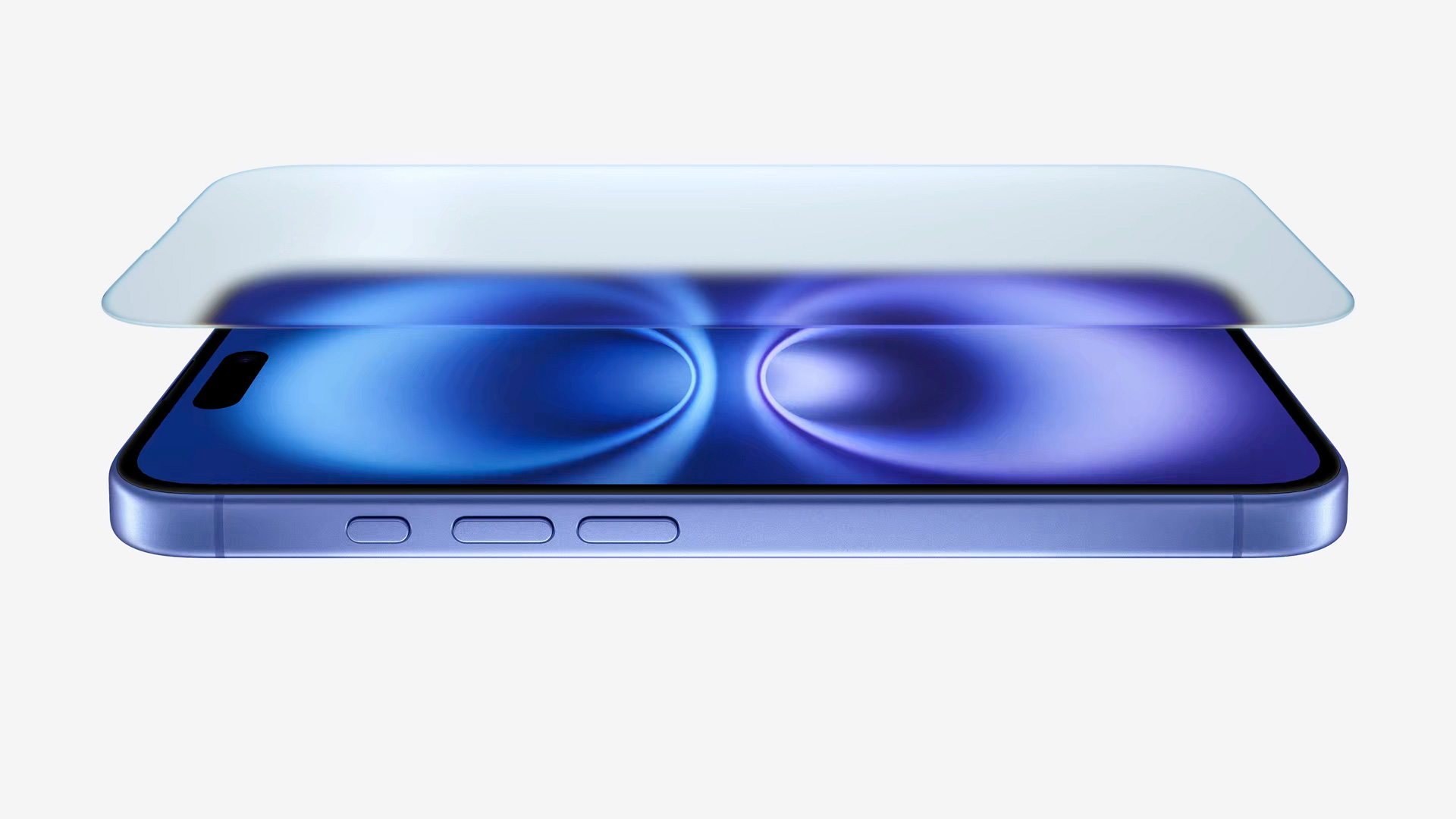
Ceramic Shield is a glass ceramic, with ceramic nanocrystals grown inside the glass so cracks have a harder time spreading. Apple said it developed the material with Corning, and Corning is reported to make it only for Apple.
By May 2021, Apple’s newsroom says, Corning had received $450 million from Apple’s Advanced Manufacturing Fund over four years. That money also backed wider manufacturing capacity and research, but Apple said its investment helped create Ceramic Shield. Our read is that Apple treats the front glass as part of the product, so no rival can match an iPhone’s front by buying the same glass.
When it launched in 2020, the headline was 4x better drop performance than the iPhone 11. MacRumors noted Apple has usually marketed drops more than scratches, and Ceramic Shield 2 shifts that toward scratches and glare.
At the iPhone 17 Pro launch, Apple said the new Apple-designed coating gives 3x better scratch resistance and improved anti-reflection. It reads like a company that considers cracks mostly handled and is now going after the everyday annoyances.
Apple’s iPhone 18 Pro pages publish no scratch figure, so the 3x belongs to the iPhone 17 generation. The closest outside test, JerryRigEverything’s on the iPhone 17 Pro, left only light marks at Mohs level 7 and nothing at level 6.

Samsung: glare is the problem it pays to solve
Corning calls Gorilla Armor 2 the first scratch-resistant, anti-reflective glass ceramic for phones. Samsung says it first partnered with Corning in 1973, and the glass is exclusive to the Ultra.
In its own lab tests Corning says Armor 2 survived 2.2-meter drops onto a surface replicating concrete and showed over 4x the scratch resistance of competing glass with an anti-reflective coating.
Samsung adds the Privacy Display, which it calls the first built-in one on a phone. Its own footnote notes some content may still be visible depending on angle or brightness.
Together, that describes a phone built for people who use a big screen outdoors and in public, which fits who buys an Ultra. Cutting glare and blocking side glances both protect the same thing, your view of your own screen.

Google: Victus 2 with an anti-scratch coating
The Pixel 11 Pro uses Gorilla Glass Victus 2, a Corning glass announced in 2022 to survive drops on rough surfaces like concrete while keeping the original Victus’s scratch resistance. Google adds a coating it says has “more than double the scratch resistance of the previous generation.”
That claim is measured against the Pixel 10 Pro in internal testing of pre-production phones, so it says little about how the phone stacks up against an iPhone or a Galaxy.
Google hasn’t said why it chose this route. It looks like the safe middle: a proven glass, a coating on top, and a bright panel for sunlight, from a company that spends its attention on cameras and software.
The glass doesn’t change the OLED, but it changes how much of it you see
All three screens are OLED, and glass doesn’t make pixels work better. What it changes is how much of the screen’s light reaches your eye compared with the light bouncing off the surface. In sunlight a phone can fight that two ways: cut the reflection at the glass, or turn the panel brighter.
Samsung and Apple lean on the glass. The Samsung S24 Ultra launch release said Corning’s original Gorilla Armor reduces reflection by up to 75% against typical glass, and Apple lists an anti-reflective coating on the iPhone 18 Pro.
Google’s spec page lists no anti-reflective coating, though that doesn’t mean the phone has no reflection handling. Its 3,600-nit peak is measured at a 5% on-pixel ratio, so a full screen of text gets less. In practice, Google seems to lean on the panel where Samsung leans on the glass.
Brightness numbers are reported three ways. Apple lists 1,000 nits typical, 1,600 HDR and 3,000 outdoor with no test conditions, and Samsung rates the S26 Ultra at 2,600 nits while Tom’s Guide measured 1,806.
What sits under the glass is converging
Korean outlets The Elec and ETNews report that Samsung Display and LG Display will supply the iPhone 18 Pro’s OLED panels, and 9to5Google notes Google has used Samsung’s panels for years. If that holds, the three brands buy much of their screens from the same few factories.
The Galaxy S26 Ultra’s 6.9-inch panel runs 3120 x 1440, the iPhone 18 Pro’s 6.3-inch screen is 2622 x 1206 at 460 ppi, and the Pixel 11 Pro’s is 2856 x 1280 at 495 ppi. None of the companies says why it chose its resolution, and for most people reading text at arm’s length the difference is probably invisible.
The panel suppliers may overlap, but the glass, coatings and optical treatments remain separate choices. That’s where the manufacturers can differentiate how the same basic OLED technology looks and feels.
Why scratch and drop claims don’t line up
Scratch resistance and impact resistance are different engineering targets. A glass’s surface hardness doesn’t tell you how well it will resist cracking in a drop, so makers have to balance the two.
Each glass answers that differently. Ceramic Shield and Gorilla Armor 2 are glass ceramics, while Victus 2 is Corning’s balanced glass, built to survive drops on rough surfaces without giving up scratch resistance.
Armor 2’s headline is drops, with Corning’s 2.2-meter concrete-like result, while Corning’s Victus 2 claim is 1 meter on concrete-like and 2 meters on asphalt-like surfaces. Those are separate lab setups, so even the drop numbers don’t line up.
After the S25 Ultra scratched earlier than the S24 Ultra, JerryRigEverything’s Zack Nelson speculated the original Gorilla Armor might have been “a tad too brittle”, as Tom’s Guide reported. That raises the possibility that Samsung and Corning chose a different balance of scratch and impact resistance for Armor 2, but the available tests don’t show it was a deliberate trade-off.
Corning also says competing glass ceramics failed from a one-meter drop in its lab, a claim that deserves an independent test.
Cracks aren’t only a slab-phone problem. Apple’s foldable iPhone Duo uses a different inner cover, yet Apple has reportedly told repair techs to inspect cracked units, which we covered.
Frequently Asked Questions
Why do Apple, Samsung and Google use different screen glass?
No company says. It looks like each guards against a different failure: Apple built its own glass with Corning, Samsung chose glare reduction on its top phone, and Google took Corning’s balanced glass. None of the three publishes what its glass costs, so cost can’t be ruled in or out.
Is Ceramic Shield 2 better than Gorilla Armor 2?
No test compares them on the 2026 phones. In separate JerryRigEverything tests, Ceramic Shield 2 on the iPhone 17 Pro showed light marks at level 7, while Gorilla Armor 2 on the Galaxy S25 Ultra scratched at level 6. Those are different phones and not a controlled head-to-head.
Does the Pixel 11 Pro have an anti-reflective coating?
Google’s spec page doesn’t list one. It lists Gorilla Glass Victus 2 with an anti-scratch coating.
Does the Galaxy S26 Ultra use Gorilla Armor 2 on the back?
No. Samsung says Gorilla Armor 2 is on the front and Gorilla Glass Victus 2 is on the rear.
Do these glasses make a screen protector unnecessary?
None of the makers’ scratch figures promises scratch-proof glass. They are lab results against earlier glass or unnamed competitors.
Which phone has the brightest screen?
On ratings, the Pixel 11 Pro leads at 3,600 nits peak, then the iPhone 18 Pro at 3,000 outdoor and the Galaxy S26 Ultra at 2,600. The companies measure differently, and Tom’s Guide measured the S26 Ultra at 1,806 nits.
What each glass says about the company that chose it
So is it just cost? Probably not. Apple spent its way into owning the material, Samsung put its newest glass on the phone where a big bright screen is the pitch, and Google took a proven glass that does the job.
Cost may still explain Google’s choice, but none of the three publishes it, so we can’t test that.
Each choice leaves a failure open. The iPhone 18 Pro has no published scratch or drop figure, Samsung’s scratch claim is a Corning lab result and the outside test of Armor 2 scratched at level 6, and Google’s claim is relative to last year’s phone with no anti-reflective coating listed.
Ceramic Shield 2 has the strongest scratch result among the outside tests cited here, though that doesn’t prove it beats Gorilla Armor 2 head to head. None of the tests covers all three 2026 phones, so any ranking is an informed read of company claims.
Samsung’s stack suits sunlight and train readers, Apple’s suits people who want a known quantity, and Google’s suits people who use a case anyway.