Quick Summary
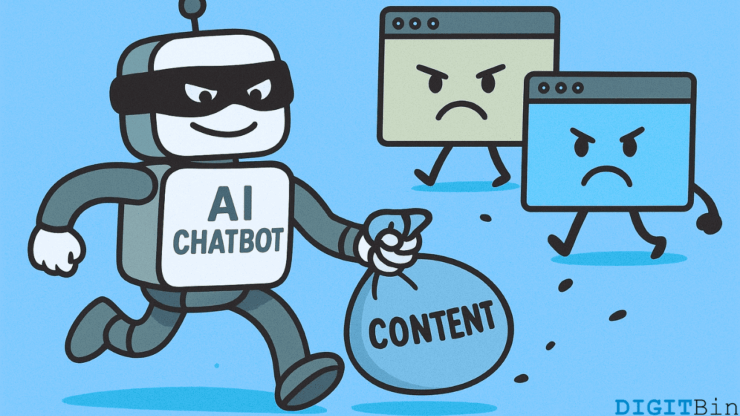
AI chatbots like Gemini and ChatGPT are scraping content and presenting it in a clean format, all in the name of artificial intelligence.
AI-based, powerful LLMs like ChatGPT, Perplexity, Claude, and Gemini are being heralded as the hottest tech innovations of this decade. In fact, they are dubbed to produce better search results compared to Google or similar contemporary search engines.
However, with the use of independent and integrated AI chatbots, the search results have become chaotic. In the good old days, Google search result was topped by websites that had actual data-backed, helpful content you would find on the first page of the search results.
AI chatbots have reportedly distorted the entire search engine results equation. Users and web publishers complain that AI chatbots are scraping content from unreliable sites, creating unhelpful content.
This means using AI chatbots to acquire information may result in receiving wrong data or insufficient information that won’t serve your purpose. Content scraping is something that Google has always opposed to make way for SEO-rich, genuinely human-produced content.
The problem with AI chatbots taking over search results
In my research for this topic, I came across an interestingly consistent view of the netizens. Most suggested that the AI-based LLMs had to be the eventual death sentence for already-sabotaged and seemingly unmanaged Google search rankings, letting unhelpful content rank in the search results and getting picked by the AI chatbots.
You don’t even have to dig further for truth on AI chatbots, simply extracting, repackaging the existing content (that too unhelpful one), and producing promptly when shot with a query. In some of my interactions with ChatGPT, it has offered outdated and invalid information by grabbing it from the internet search results.
Disappointed, I began searching manually on the internet to gather useful information on the subject I was trying to learn. This clearly negates the presence and use of AI chatbots. Adding to the issue, AI chatbots’ content reuse without attribution has devalued the original blog/site where the content was produced, while also affecting their site revenues. The lower site traffic resulted in lower revenue, negatively impacting the site’s business.
Understanding the role of AI chatbots in content scraping
Scraping of content refers to copying content from one portal and publishing it with little to no changes on another site. Google was always against it so that originality and value of content could be maintained.
Back in 2011, Google rolled out the Panda update to prevent content scraping by bogus websites to help the sites rank that produced original content. Having worked with numerous popular tech blogs in the past as a writer, the cardinal rule was to brainstorm and create original content. That concept worked well in producing thousands of helpful blogs, listicles, news, and similar content.
However, AI LLMs are now easily lifting content from random websites (including the ones offering valuable content) to provide to their users, and the idea of content originality has become a thing of the past. To manage the frustrating situation of web media publishers, Google is emphasizing the EEAT format for web content. EEAT is the abbreviation for Experience, Expertise, Authority, and Trustworthiness.
While EEAT can be an efficient catalyst in producing helpful original content, the messed-up search algorithm update has seemingly prevented such content from ranking and causing AI chatbots to scrap the unhelpful content and ranking on the first page, further misleading the users.
AI chatbots are hurting the blogging/web publishing economy
I have obtained this tabular data from polls/surveys/research that exhibit how AI chatbots scraping the content from the site where it originated has affected the clickthrough rate, revenue, and user traffic.
| Dataset | Report | Source |
| Research by the Pew Center on the effect of AI Summarization on search query results | AI summaries cut traffic and ad revenue nearly in half | Pew Research |
| Report on Lawsuit between OpenAI and The New York Times | A media publisher sued an AI company for using its content, citing copyright infringement and the devaluation of content. | Harvard Review |
| Data on AI Overview Sabotaging Site Traffic and Presence | Referral traffic down by 10%, traffic of non-news brands and news brands are down by 14% and 7% respectively. | Digital Content Next |
AI has managed to use the content from its original producers and pushed the latter down the search rankings while promoting itself to the users. It has clearly left a massive blow on the web content publishing economy, badly affecting the viewership and revenue.
To make matters worse, media publishers cannot block Google’s AI crawler from scraping their content because doing so would block the Google search crawler as well. As a result, publishers are unable to prevent AI chatbots from scraping their content and causing a significant drop in their outreach and revenue.
AI chatbots: innovation or modern machines repackaging old content
Google once focused on the “content for the human, by the human” policy to promote legitimate content that can rank and provide value. Following the current scenario, it seems Google is now letting its AI scrape whatever data is possible from the corners of the web and redirect it to the devices of its users, in a bid to push the integration of AI.
The search algorithm update doesn’t seem to have done much in terms of improving and bringing back the lost foothold of the popular blog sites and media outlets that once helmed the first page of the search results.
What do you think? Is the era of helpful human-oriented blogs/web media over, and is AI the new world order dominating the information exchange, but with scraped, limited, and regurgitated content? Let me know in the comments.
If you've any thoughts on AI Chatbots have Become What Google Hates – Content Scrapers, then feel free to drop in below comment box. Also, please subscribe to our DigitBin YouTube channel for videos tutorials. Cheers!